

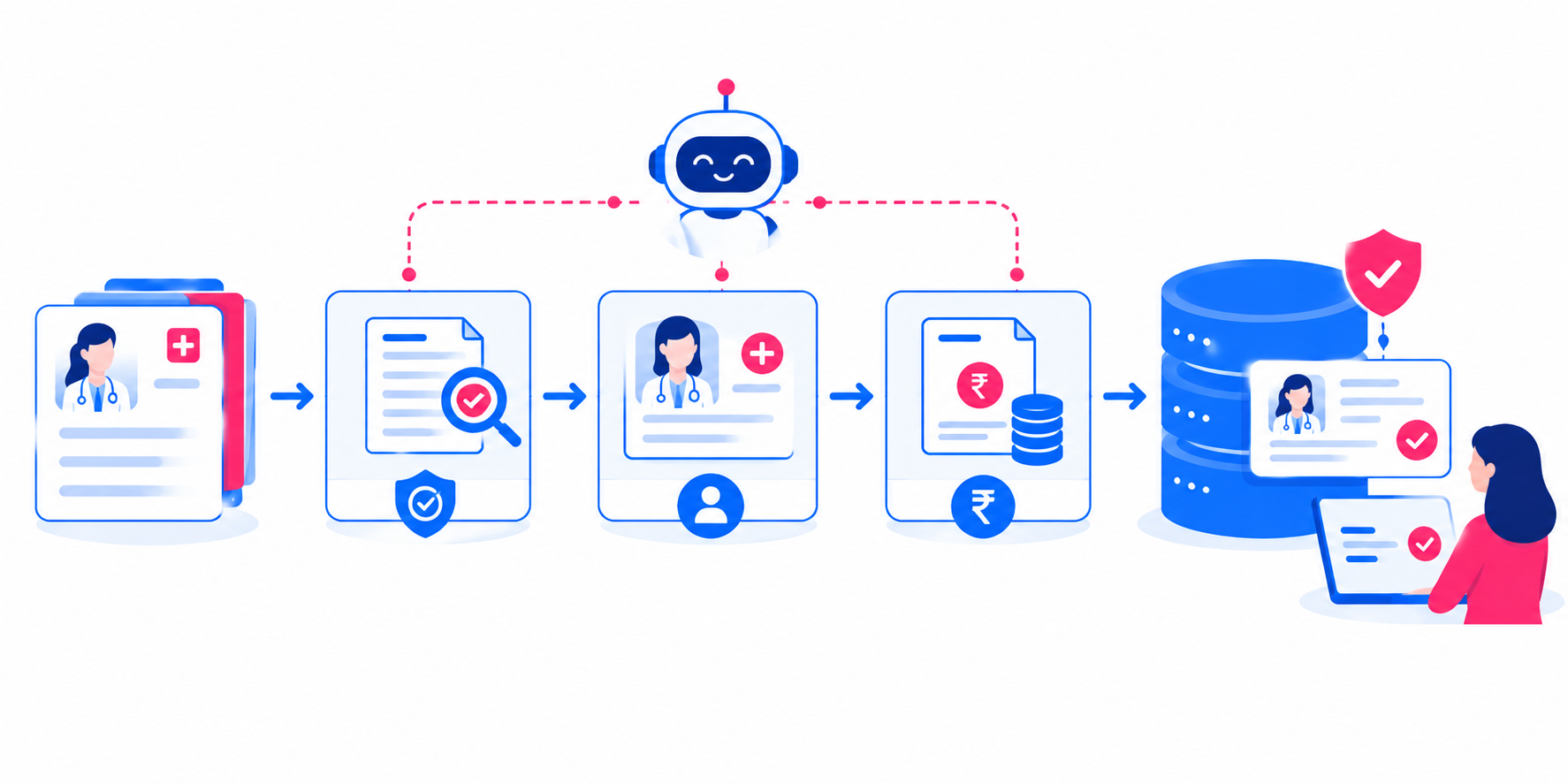
A chatbot answers a question. An agent finishes the job. That difference is why agentic AI is drawing so much attention across insurance operations, where work rarely ends with a single answer. But an agent is only as dependable as the architecture around it, and getting that design right is what separates a promising demo from a system you can trust with real claims and real policyholders.
What Makes Agentic AI Different
Traditional AI in insurance typically performs one narrow task: classify a document, score a risk, predict a likelihood. Agentic AI goes further. An agent can take a goal, break it into steps, use tools and systems to carry those steps out, check its own progress, and adapt when something unexpected happens.
In practice, that might mean an agent that receives a new claim, gathers the policy details, requests missing documents from the claimant, checks coverage, and prepares a recommendation for an adjuster, all with minimal hand-holding. This autonomy is powerful, but it also raises the stakes for design. The more an agent can do, the more carefully its boundaries need to be built.
Start With the Right Use Cases
Not every insurance process suits an agent. The best candidates share a few traits: multiple steps, information spread across systems, clear success criteria, and a manageable level of risk if something goes wrong. Claims intake and triage, policy servicing requests, underwriting submission preparation, and broker inquiries all fit this profile.
High-stakes decisions, such as final claim denials or complex coverage determinations, are better suited to agents that assist and recommend rather than decide. Choosing use cases with this in mind keeps early deployments valuable and safe and builds the organizational confidence needed to expand later.
The Core Layers of the Architecture
A sound agentic AI architecture is built in layers, each with a distinct job. Thinking in layers makes the system easier to build, test, and govern.
The Reasoning Layer
At the center sits a large language model that interprets requests, plans steps, and decides which actions to take. Insurers should treat this model as a replaceable component rather than the foundation of the whole system. Models improve quickly, and an architecture that can swap them without a rebuild protects the investment.
The Orchestration Layer
Orchestration manages how work flows. It tracks the state of a task, sequences steps, coordinates multiple specialized agents when needed, and handles retries or escalations. For example, one agent might handle document extraction while another verifies coverage, with an orchestrator tying their outputs together. Keeping agents specialized and narrowly scoped generally produces more reliable results than a single agent trying to do everything.
The Tools and Integration Layer
Agents become useful when they can act, and in insurance that means connecting to policy administration systems, claims platforms, document repositories, and external data sources through APIs. Each tool should be defined clearly, with explicit inputs, outputs, and permissions. Well-designed integrations also return clear errors so the agent can recover gracefully instead of guessing.
The Knowledge and Memory Layer
Agents need access to the right information at the right time: policy wordings, underwriting guidelines, regulatory requirements, and the history of the case at hand. Retrieval systems ground agent responses in approved sources rather than relying on the model’s general knowledge. Short-term memory keeps context within a task, while carefully governed long-term memory can preserve relevant history without exposing sensitive data unnecessarily.
Guardrails and Human Oversight
Because insurance is a regulated, trust-driven industry, guardrails are not an optional add-on. They are a core part of the design.
Effective guardrails operate at several points. The input checks screen for manipulation attempts and malformed requests. Action limits define what an agent can and cannot do, such as read data freely but require approval before issuing a payment or changing a policy. Output checks verify that responses are accurate, compliant, and appropriately worded before they reach a customer.
Human-in-the-loop design deserves particular attention. Rather than treating human review as a failure of automation, mature architectures build in deliberate checkpoints, triggering review based on risk, claim value, confidence level, or customer vulnerability. This keeps accountability where it belongs while still capturing most of the efficiency gains.
Security, Privacy, and Access Control
Agents often touch sensitive personal, financial, and health information, so security has to be built in from the start. Each agent should operate with the minimum access required for its task, using scoped, time-limited credentials rather than broad permissions. Data should be encrypted, and prompts and outputs should be logged carefully, with sensitive fields masked where appropriate.
Insurers should also plan for agent-specific threats, such as prompt injection, where malicious content embedded in a document or message tries to redirect the agent’s behavior. Treating all external content as untrusted and separating instructions from data helps contain this risk.
Observability and Continuous Evaluation
An agent’s reasoning path isn’t always obvious from its final output, which makes observability essential. Teams need detailed traces showing what an agent was asked, which tools it used, what data it retrieved, and how it reached its conclusion. This supports debugging, audits, and regulatory inquiries.
Evaluation should be continuous, not a one-time launch test. Insurers can build test suites from real, anonymized scenarios, including edge cases and adversarial inputs, and track metrics such as task completion rate, accuracy, escalation rate, and customer outcomes. Models and prompts change, so regular re-testing keeps quality from quietly drifting.
A Phased Path to Adoption
Few insurers should jump straight to fully autonomous agents. A more practical path begins with agents that assist staff, drafting summaries or gathering information while humans act. As performance is proven and monitoring matures, agents can take on more tasks independently within clearly defined limits. This staged approach builds trust among employees, regulators, and customers and surfaces problems while the consequences are still small.
Conclusion
A strong agentic AI architecture for insurance rests on clear layers, firm guardrails, careful security, and constant measurement. Insurers that design for control as deliberately as they design for capability will be the ones able to scale agents across operations with confidence.


