

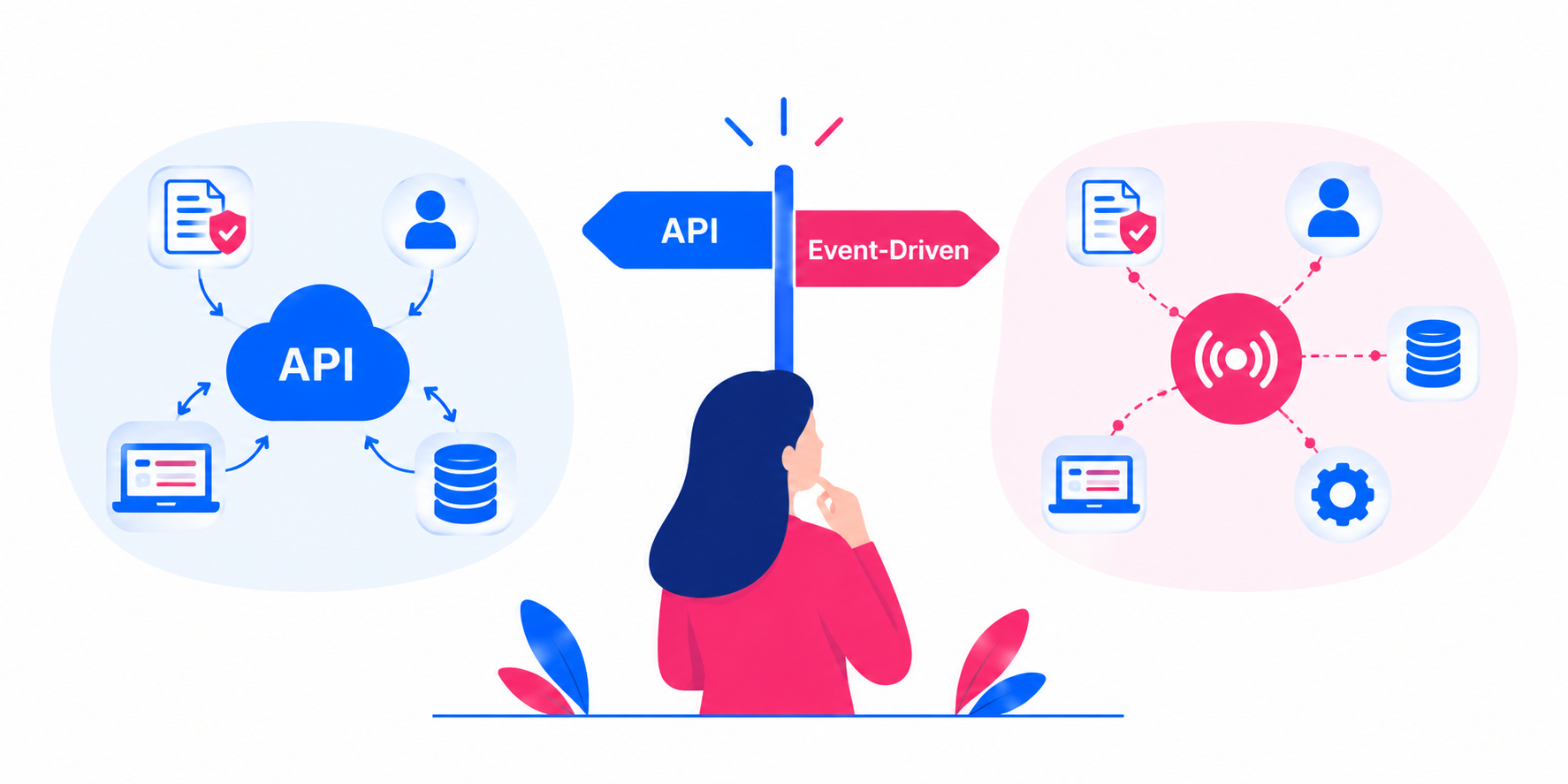
Ask a system a question and wait for the answer, or let the system tell you the moment something changes. That’s the heart of the choice between API-first and event-driven architecture. Both have earned a place in modern insurance, and picking the wrong one for a given job leads to slow, brittle systems. The real question isn’t which is better, but which fits the work in front of you.
What API-First Architecture Means
In an API-first approach, systems are designed around well-defined interfaces from the start. One system makes a request through an API, such as asking for a quote or a policy’s status, and receives a response. This request-and-response pattern is direct, predictable, and easy to reason about.
For insurance, this model fits any interaction where someone or something needs an answer right now. A broker portal requesting a premium, a mobile app displaying coverage details, or a partner platform binding a policy at checkout all depend on a fast, reliable API response. The caller waits, gets a result, and moves on.
What Event-Driven Architecture Means
Event-driven architecture works differently. Instead of one system asking another for information, systems publish events, which are records that something happened, such as a claim being filed, a payment failing, or a policy being renewed. Other systems subscribe to those events and react when they occur, without the publisher needing to know who is listening.
This decouples systems from one another. When a claim is filed, one service can start fraud screening, another can notify the policyholder, and a third can update reserves, all triggered by the same event and all running independently. Nothing is waiting on anything else, which makes the architecture flexible and resilient as the business grows.
When API-First Is the Right Choice
API-first is the better fit when the interaction is synchronous and the caller needs an immediate answer. Several insurance scenarios stand out:
- Quote and bind flows. A customer or partner needs pricing and confirmation in seconds, and the experience breaks if the response is delayed.
- Embedded insurance and partner integrations. External platforms expect a clean, documented API they can build against quickly.
- Data lookups. Retrieving a policy, checking eligibility, or confirming coverage are classic request-and-response tasks.
- Customer-facing apps and portals. Interfaces that display live information depend on predictable API calls.
An API-first approach also makes systems easier to govern. Each interface can be versioned, secured, documented, and monitored individually, which matters in a regulated industry where access to sensitive data must be controlled and auditable.
When Event-Driven Is the Right Choice
Event-driven architecture shines when many things need to happen in response to a single occurrence, or when work doesn’t need to finish instantly. Strong insurance use cases include:
- Claims workflows- A filed claim can trigger document requests, fraud checks, adjuster assignment, and customer notifications in parallel.
- Policy lifecycle changes- Renewals, cancellations, and endorsements ripple across billing, documents, and reporting systems.
- Real-time monitoring- Telematics, IoT sensors, and payment signals produce streams of data that need continuous processing.
- Integration across legacy systems- Events can connect older platforms without forcing tight dependencies between them.
Because producers and consumers are decoupled, teams can add new reactions to an event without modifying the original system. That makes it far easier to evolve insurance operations over time without risky, system-wide changes.
The Trade-Offs to Weigh
Neither approach is free. API-first designs can create tight dependencies. If one service is slow or unavailable, every system waiting on its API response feels it, and long chains of API calls can become fragile. Managing many APIs also demands strong versioning discipline.
Event-driven systems bring different challenges. Behavior is spread across many independent consumers, so tracing what happened and why can be harder. Event ordering, duplicates, and failures need careful handling, and debugging requires solid observability tooling. In insurance, where audit trails matter, teams must make sure every event and reaction is logged and traceable.
Using Both Together
In practice, most mature insurers use both, because the two patterns complement each other rather than compete. A common design looks like this: a customer submits a claim through an API, which returns an immediate confirmation. Behind the scenes, that submission publishes an event, and downstream services pick it up to handle verification, assignment, notifications, and analytics.
The API handles the moment that needs a quick answer. The events handle everything that follows. This hybrid pattern gives customers speed and gives operations flexibility, and it’s increasingly the default design for modern insurance platforms.
Where Agentic AI Fits In
The rise of agentic AI makes this choice even more relevant. AI agents need both patterns to work well. They call an API when they need to act or retrieve information, such as checking coverage or updating a record. They also benefit from events, which can wake an agent when something meaningful happens, like a claim reaching a certain stage or a document arriving, rather than forcing it to poll systems constantly.
Well-defined APIs give agents clear, controllable actions with scoped permissions, while event streams give them timely context. Insurers planning for agentic AI should treat both as part of the foundation, since a platform with clean APIs and reliable events gives agents a safe and efficient environment to operate in.
A Simple Decision Framework
When choosing between the two, a few questions help:
- Does the caller need an immediate answer? If yes, lean toward an API.
- Do multiple systems need to react to one occurrence? If yes, lean toward events.
- Is the work long-running or asynchronous? Events usually fit better.
- Is an external partner integrating? A well-documented API is typically expected.
When the answer is mixed, combine them.
Conclusion
API-first and event-driven architecture solve different problems in insurance: one delivers fast answers, the other coordinates what happens next. Insurers that match each pattern to the job, and combine them where needed will build platforms ready for both today’s operations and the rise of agentic AI.


