

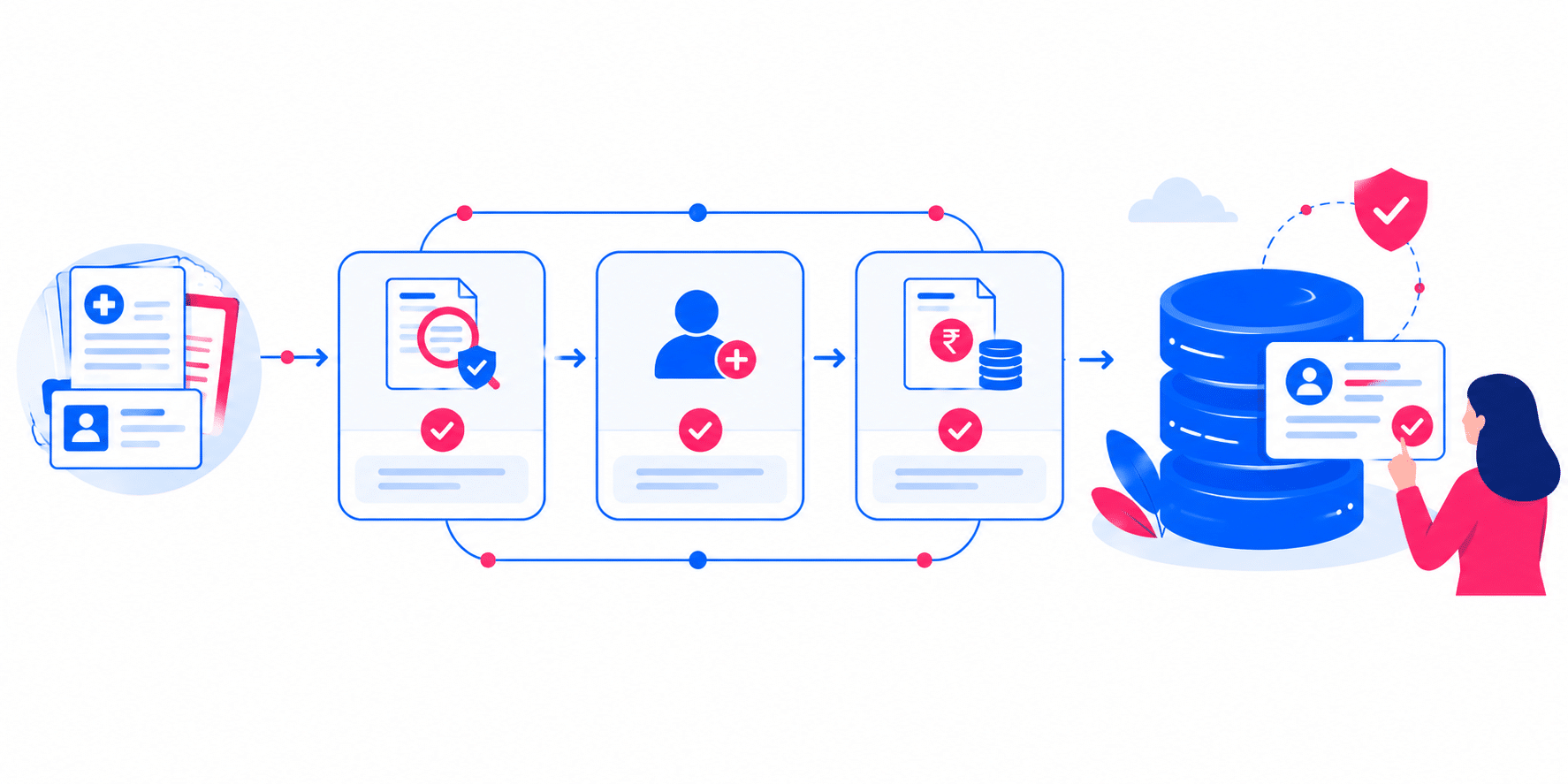
Managing a healthcare provider network requires insurers to coordinate provider information, documentation, accreditation, empanelment activities, and financial verification. When these activities depend on offline forms, spreadsheets, and manual follow-ups, teams can face duplicate data entry, inconsistent records, and limited visibility into pending work.
One of India’s Health insurance providers needed a more centralized way to manage provider operations across the provider lifecycle. iNube implemented a Provider Management & Empanelment System that digitized provider information capture, introduced workflow-driven processing, and strengthened controls around provider data and financial verification.
Our Client at a Glance
One of India’s Health insurance providers manages a provider network comprising network and non-network providers, alongside de-empanelled providers and records that have completed financial verification.
The provider operations team needed a consistent way to maintain provider information and manage activities across onboarding, empanelment, renewals, modifications, and related workflows.
Key Challenges Confronted by the Client
Manual and Excel-Driven Provider Onboarding
Provider information was captured offline and then manually transferred or uploaded into the core application. This created duplicate data-entry effort, increased the possibility of errors, introduced dependency on individuals and delayed provider creation. Maintaining a consistent provider master was also difficult.
Limited End-to-End Visibility of Provider Processing
Provider records moved through multiple stages without a centralized workflow, tracking the status of each provider and identifying pending actions required manual effort.
Data Quality, Duplication and Control Risks
Duplicate provider entries could result in multiple provider IDs, incorrect network status, duplicated financial information, and reporting inconsistencies. The provider master needed stronger checks to support consistent records and reliable downstream operations.
Financial and Payment Data Risk
Provider bank account, PAN and TDS information directly affect payment processing. These details required a defined verification process, access to supporting documents, and a record of decisions. Changes to financial information also need to trigger re-verification.
Technological Solutions Implemented
iNube implemented a centralized Provider Management & Empanelment System to digitize provider information capture and manage provider operations through controlled workflows.
The solution supports the provider lifecycle, from onboarding and empanelment to SOC configuration, MOU generation, financial verification, modification, renewal, monitoring and de-empanelment.
Structured Digital Provider Registration
Provider information is captured through structured digital forms rather than being collected offline and manually transferred into the application.
The system supports provider registration details covering accreditation, ownership, IT facilities, infrastructure, rooms and wards, medical facilities, and supporting documentation.
Workflow-Driven Dashboards
Dedicated work buckets provide visibility into pending activities and allow users to open the relevant transaction directly.
Provider Management activities
This moves provider processing away from person-dependent tracking towards system-driven workflow management.
Provider De-Duplication and Code Generation
The solution applies provider de-duplication logic using provider name, PIN code, city, mobile number and email ID.
Provider-code generation follows defined business logic, supporting a more consistent provider master and reducing the risk of duplicate records.
Financial Verification Controls
A dedicated Finance role and Financial Verification Pending dashboard support the review of provider financial information.
Finance users can view financial details and supporting documents, re-enter the bank account number, verify or reject details, and record remarks.
When relevant financial information changes, the record is automatically sent back for re-verification. Verification actions are captured in the audit log, including the trigger, user, remarks, date and time.
These controls introduce a formal maker-checker-style verification process for provider financial information.
Role-Based Access, Data Masking and Auditability
The system supports controlled status transitions, data masking and audit trails. Together with role-based work queues and financial verification, these controls strengthen accountability and help users manage provider operations through defined processes.
Search and Customized Reporting
Users can search for providers, manage provider lifecycle activities and generate or download customized reports. This reduces reliance on manual offline processes for routine information retrieval and reporting.
Merging Efficiency and Control: Business Benefits
Digitized Provider Operations
Replaced fragmented manual and Excel-based activities with a centralized digital process.
Standardized provider information capture through structured digital forms.
Improved Workflow Visibility
Introduced role-based dashboards and dedicated work buckets for pending activities.
Enabled users to access relevant transactions directly from workflow dashboards.
Stronger Provider Data Governance
Introduced de-duplication checks using provider name, PIN code, city, mobile number and email ID.
Established provider-code generation based on defined business logic.
Enhanced Financial Verification and Auditability
Added financial verification with verify/reject actions, remarks and re-verification when relevant information changes.
Recorded verification actions in audit logs and supported controlled status transitions and data masking.
Reduced Dependence on Offline Processes
Enabled provider search, lifecycle management and customized report generation and downloads through the system.
Decoding the Impact
- Non-network providers – 5k+ enrolled in the last six months
- Network providers- 11k+ providers enrolled in the last six months
Conclusion
iNube transformed one of India’s Health insurance providers’s provider management operations from a predominantly manual and Excel-driven process into a centralized, workflow-based digital system.
By combining structured forms, workflow dashboards, provider deduplication, financial verification, audit trails, search, and customized reporting, the platform reduced reliance on fragmented offline activities and strengthened visibility, data consistency, and operational control across provider management.
The result is a more controlled and transparent approach to managing the provider lifecycle through a single system.