

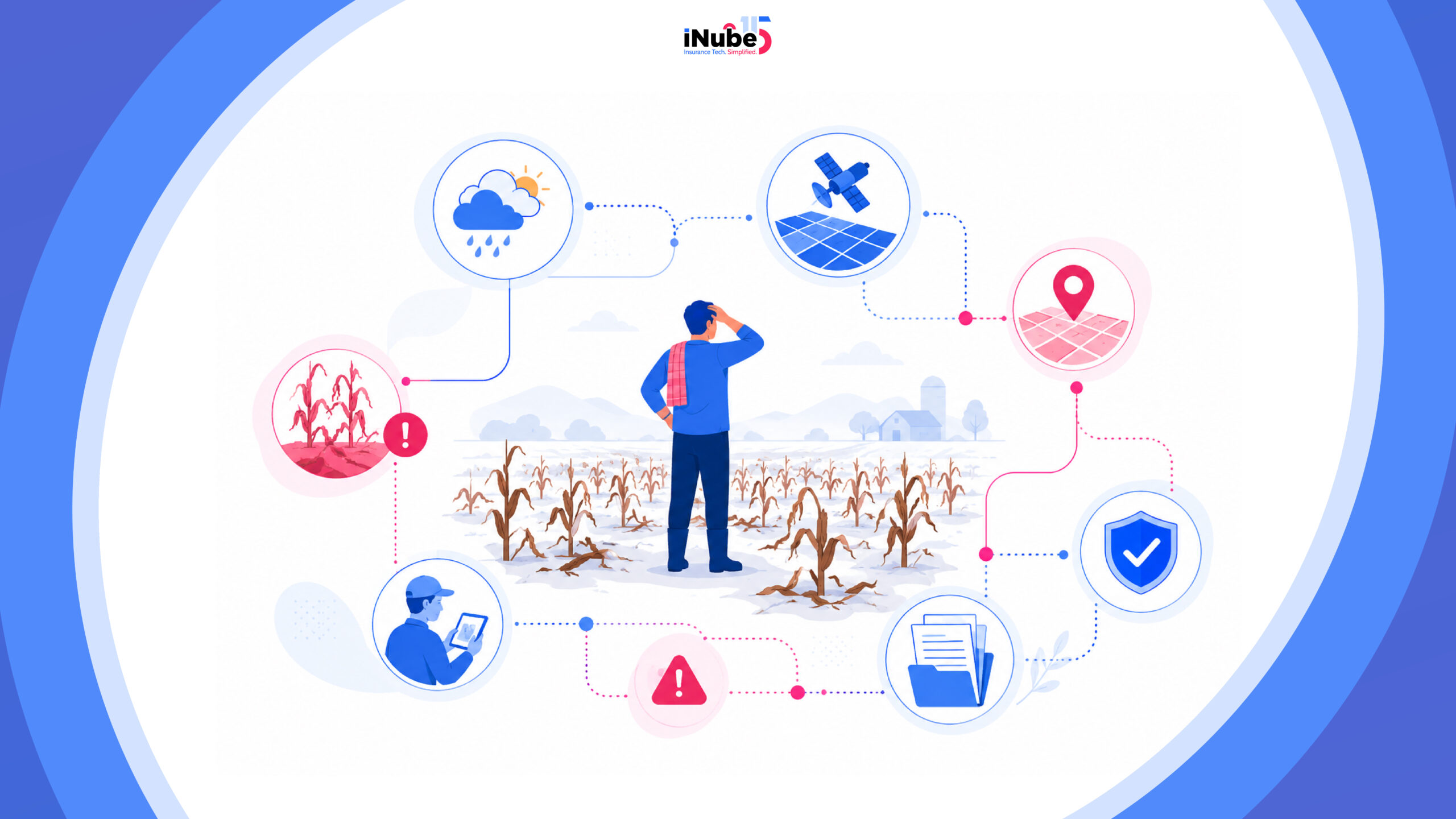
Crop insurance was always looked at as an arrangement that was as straight as a line. Something that always began with a farmer suffering a crop loss, filing a claim, and then receiving the compensation. However, in reality, crop insurance claims are among the most complex processes in the insurance industry. It’s unlike motor or Health insurance, where a loss is typically linked to an individual policyholder and a clearly identifiable event, but in crop insurance, multiple stakeholders are involved.
This complexity is clearly visible in the Indian crop insurance landscape, which serves as a critical financial safety net for millions of farmers under the scheme Pradhan Mantri Fasal Bima Yojana (PMFBY). This article will be shedding some light on the complexity of crop insurance claims that conveniently lie underneath.
Where does Crop Insurance stand out?
Most of the crop insurance protects an individual asset, and this includes a vehicle, a home, or a person’s health. However, crop insurance is all about protecting agricultural output, which is essentially influenced by the numerous variables that go beyond the control of the farmers.
It heavily depends upon the multiple factors that differentiate crop insurance from the other business lines.
Behind the complexity lies the story that no one tells
One of the first and biggest misconceptions about Crop Insurance is that the crop damage is always obvious.
However, in reality, most of the agricultural losses develop gradually.
For instance, excess rainfall may damage the root systems long before visible symptoms appear. In another instant, pest attacks can damage and affect the crop quality instead of quantity. These are a few of the instances that impact crop insurance operations and add to its complexity. Unlike the regular Motor claim, where damage can be immediately inspected, agricultural losses would often require scientific assessment and yield estimation before the compensation can be determined.
This is exactly what causes inherent complexity in the claim evaluation.
Claims are based on area yield and not individual farm losses
One of the most important and pivotal aspects of India’s crop insurance ecosystem is the area approach that is used by Pradhan Mantri Fasal Bima Yojana (PMFBY).
Under this model, the compensation is essentially determined on the basis of the average yield of a notified area instead of the loss that is suffered by an individual farmer.
Why does this matter?
A farmer might be experiencing a significant amount of crop damage while the neighboring farms essentially remain relatively unaffected. However, conversely, a farmer might be receiving compensation even if their individual loss is much lower than their area average.
The claim outcome here essentially depends upon threshold yield, actual yield, insurance unit performance, and the crop-cutting experiment results. This is the approach that truly helps to scale Agri insurance for millions of farmers but also seamlessly introduces the challenges that are related to perception, transparency, and claim acceptance.
Yield estimation is a massive operational exercise
The most important thing to understand is that determining crop loss at scale essentially requires extensive field-level assessments. This is how, traditionally, insurers and the state governments rely on Crop Cutting Experiments (CCE) to estimate the yields. These are the experiments that essentially involve selecting the sample plots, harvesting the crops manually, measuring the output, and comparing the results against the historical benchmarks.
But challenges do persist, and these include human errors, resource constraints, geographic diversity, and data inconsistencies followed by reporting delays. To seamlessly address these issues, the government is promoting technologies that include remote sensing, satellite imagery, drones, and the Yield Estimation System by using technology and, in this case, YES-TECH. These are the initiatives that are primarily aimed at reducing the dependency on the manual assessments and improving the claim accuracy.
Too many stakeholders’ decisions influence one claim journey
Crop insurance claims are far more complex than most insurance claims because multiple stakeholders are involved at every stage. Farmers, insurers, government bodies, agricultural agencies, and technology providers all play a role in assessing losses and settling claims. With so many participants contributing to the process, ensuring accuracy, transparency, and timely payouts becomes a challenge in itself.
Weather plays a pivotal role in the claims journey
For weather-based insurance products, claim decisions often rely on weather station data rather than physical field inspections. While this improves scalability, it can also create what is known as basis risk. This is a situation where a farmer experiences actual crop damage, but the weather data does not fully reflect the loss. This gap between real-world impact and recorded data can sometimes lead to disputes and delays in settlement.
Technology: An anchor for insurers to expedite operational efficiency
Crop insurance has long been associated with complex processes and multiple moving parts. Today, technology is helping change that. With tools like satellite imagery, AI-driven assessments, and digital claims platforms, insurers can make faster and more informed decisions. Solutions like the iNube Crop Insurance System bring the entire process together on a single platform, making it easier to manage policies, claims, and stakeholder interactions. The result is a smoother, more transparent experience that benefits insurers and, most importantly, the farmers who rely on timely support.
Frequently Asked Questions
What is iNube Crop Insurance Software?
The iNube Crop Insurance system is specifically designed to support and streamline end-to-end crop insurance management.
Is Crop insurance technology truly useful in Crop Insurance operations?
Yes, crop insurance technology is extremely important in simplifying the complex crop insurance operations, especially in policy administration.
Is crop insurance software truly helpful?
Yes, the crop insurance software is extremely helpful for the insurers in simplifying the end-to-end crop insurance operations.