

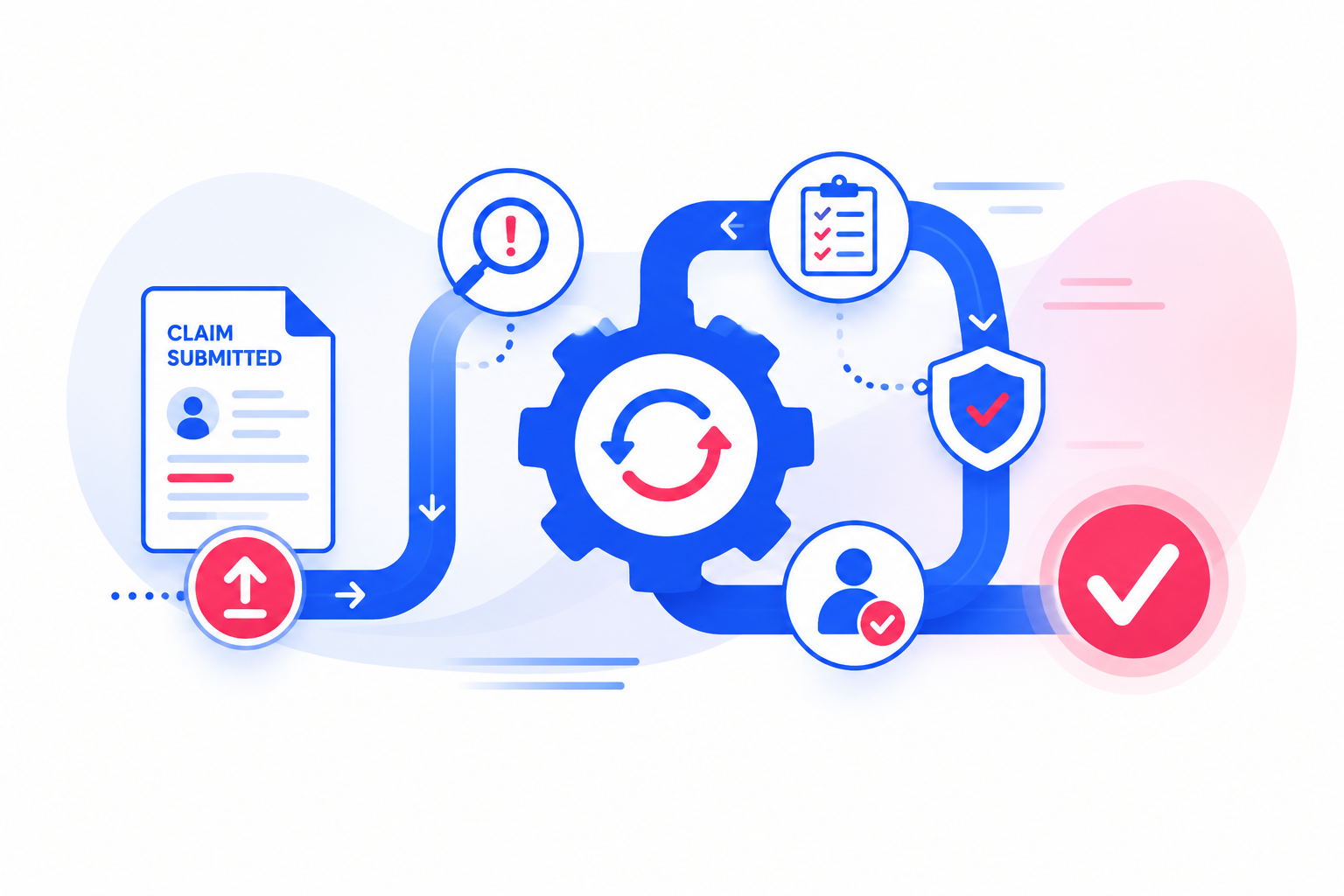
Claims management is not just a pivotal process in insurance but a part of the insurance value chain where operational friction still lives. As the insurance industry pushes deeper into digital transformation, workflow orchestration has emerged as the backbone technology that is playing a key role in turning around fragmented processes and manual processes into more connected, intelligent systems. In this article, we will be exploring workflow orchestration in brief and also why it matters for claims automation.
Complexity lingers while the talk of efficiency tops conversations
Insurance claims involve dozens of moving parts, and these briefly involve intake verification, fraud checks, adjuster assignment, document review, and multiple other processes where communication plays a key role for the policyholders. In most organizations, these are the steps that live in separate systems, including the legacy core platforms, spreadsheets, email threads, and the point solutions, which don’t really communicate with each other seamlessly.
This fragmentation is quite expensive. The manual handoffs significantly slow down the cycle time, increase the risk of human error, and make it quite difficult to handle a claims status in real time. For an industry that is built upon the trust and speed of resolution, which becomes a serious liability in the longer run. This is exactly why insurance claims processing remains one of the most cited pain points in the leadership conversations today.
What does workflow orchestration actually mean?
Workflow orchestration is the coordination layer that seamlessly connects not just specific processes but also automates the process flow. With workflow orchestration, manual dependency lessens from one department to the next. This creates an orchestration engine that triggers the next step that automatically conducts the processes on the basis of predefined rules, data inputs, or the AI-driven decisions.
You can think of it like the conductor of an orchestra. Each of the systems, which includes a policy database, a fraud detection engine, the document management tool, and a payment gateway, plays its own instrument. The workflow orchestration ensures that each of the processes plays in sync and at the right time and in the right order. This is quite different from simple task automation. A single automated task would solve one simple problem; however, an orchestration journey will solve the entire journey as it strings together dozens of these micro-automations into a coherent and end-to-end process.
What an end-to-end claims automation process looks like
Here’s what an end-to-end claims automation process looks like:
Intelligent intake
When a policyholder actively files a claim through a mobile app, portal, or call center, orchestration immediately triggers parallel processes that include policy validation, coverage checks, and the initial document collection. All these will be without having to wait for an adjuster to pick up the case.
Automated triage and routing
Rules-based or AI-driven logic assesses claims’ complexity and severity, and then it routes to an automated path while flagging complex or high-risk claims for human review.
This is exactly where claims management shifts from being a reactive to a proactive process, where the resources go where they are actually needed.
Real-time fraud and risk checks
The orchestration platforms would be flagging the fraud detection APIs, cross-referencing claims history, and flagging the anomalies almost instantly, instead of a manual review queue.
Seamless system integration
Instead of an adjuster manually re-entering the data across five different tools, orchestration pushes information between the core insurance systems, document repositories, and the third-party services automatically.
Continuous status updates
The policyholders will get real-time updates because the orchestration layer will know exactly where a claim stands at every moment. All this is without the need for someone to manually check and report back.
Why this matters beyond efficiency
While it’s quite tempting to look at it as a cost-cutting exercise, the strategic value of it runs much deeper and includes:
Accuracy and consistency
The automated workflows would apply the same rules every time, thus reducing the variability that comes from different adjusters who handle similar claims differently.
Scalability during surge events
The catastrophic events, such as hurricanes, floods, and wildfires, among others, can produce the claim volumes that would overwhelm the manual teams. The orchestrated systems will be able to absorb this surge without having a proportional increase in headcount.
Better use of human expertise
When the routine claims are automated, the adjusters and the claims professionals can focus their judgement on the complex and high-value or sensitive cases where humans would empathize with the expertise that matters.
Regulatory and audit readiness
The orchestration platforms would be typically logging every step of the claims journey, and this creates a clean audit trail, which is far more reliable than attaching together the records from multiple disconnected systems.
Conclusion
Workflow orchestration is not just another insurance technology upgrade; instead, it’s the connective layer that truly makes end-to-end claims automation possible. By coordinating with the systems, data, and decisions across the insurance lifecycle.