

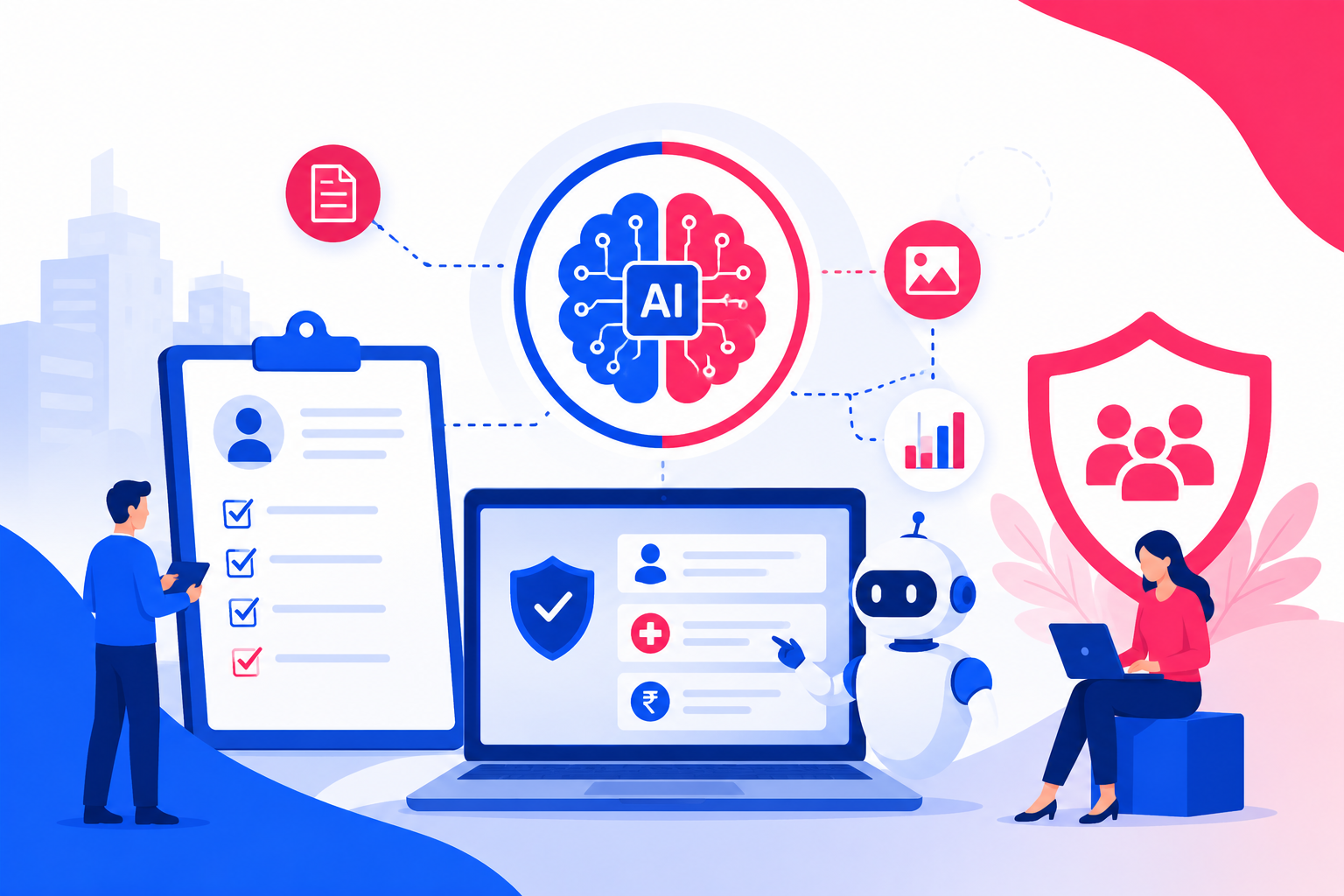
Claims management has always been at the center of operations across the insurance value chain. However, the process has widely been associated with a slow, error-prone claims process, which has led to a wider number of bad experiences across the insurance claims management process. With AI, multiple changes in the existing process are now being accompanied by proactive, data-driven decision-making. For anyone who is looking to track down the shifts happening in insurance technology, this shift will not be theoretical anymore. Instead, it is already reshaping the way claims move from submission to payout.
Intelligent triage is now a thing
For decades, claims management meant having human adjusters manually review the documents, including each file, checking documentation, and making judgment calls in one claim at a time. This is the model that does not scale well, especially as the claims volume grows, and policyholders expect much less near-instant updates.
How does intelligent triage work?
Additionally, AI has introduced intelligent triage into this process. The machine learning models are now able to assess the incoming insurance claims the moment they are filed, scoring them by their level of complexity, risk, and the likelihood of fraud. This involves having simple, low-risk claims that can be auto-adjudicated and also paid out within just hours. The complex or flagged claims will get routed straight towards the right specialist, instead of just sitting in a more generic queue. This essentially does not mean replacing humans; instead, it saves them a huge amount of time so that they focus upon the claims that actually need their expertise, while the routine cases move through the system on their own
Fraud detection is done the smart way today
Fraud has always been one of the costliest challenges in the insurance industry, and the traditional detection methods, including static rules and periodic audits, were never really built to catch interestingly sophisticated schemes. This is exactly where AI changes the detection model completely by learning from the patterns across millions of historical claims instead of relying on fixed thresholds.
This is specifically significant for Health Insurance, where fraudulent billing, upcoding, and phantom claims quietly drain the resources for years before detection before going to detection. The AI models today will be spotting subtle correlations, such as unusual provider billing patterns, mismatched diagnosis codes, or the claims adjusters who will resemble the known fraud rings, much faster than a human auditor would.
Natural language processing is cutting down on paperwork
A lot of the claims management share work has traditionally involved reading; this includes medical records, adjuster notes, provider correspondence, and appeal letters. Natural Language Processing (NLP), which is a branch of AI, will now be automating much of that reading and also the extraction work.
The NLP tools will be able to scan and understand the documents, pull out the relevant clinical or policy details, and populate the claims system automatically. This matters enormously for Health insurance claims, where a single case might include the physician notes, lab reports, and the billing codes from multiple sources. Instead of an adjuster manually cross-referencing it all, NLP does the heavy lifting in just minutes.
Predictive models are changing the way insurers plan
AI’s impact on claims management is not just limited to individual claims; instead, it’s also changing the way insurers plan at a portfolio level. The predictive models will now be able to forecast the claims volume trends, anticipate the seasonal spikes, and also estimate the reserve requirements with far more precision than the historical averages allowed.
This is the foresight that lets claims management teams staff appropriately before a surge really hits, instead of just scrambling after the volumes climb. It also allows the insurers to identify the policyholders who might be at higher risk of filing a claim soon. This enables much more proactive communication and support. As predictive analytics mature, this kind of forward-looking planning is becoming a much more standard expectation across the insurance industry; it’s not a competitive edge, but instead, it’s reserved for the largest players.
Real differentiator is the policyholder experience
Every technological shift in claims management ultimately gets judged by only one thing: the feeling that a person gets while filing a claim. The AP-powered chatbots and the virtual assistants will now be able to guide the policyholders through every claim submission in real time, answering the status questions instantly instead of just making them wait on hold. The automated status updates have replaced the old model of policyholders calling in just to check up on where their claim stands.
For Health insurance in particular, this responsiveness matters quite a lot, as the claimants are often dealing with a medical issue at the same time. This reduces the friction in the claims process, which isn‘t just an efficiency metric; instead, it’s a meaningful part of the overall care experience. The insurers who lean on AI-driven communications are seeing a measurable gain in customer satisfaction scores, which is precisely because the process feels less like a black box and more like a transparent, guided journey.
What this means for the industry
The industry is moving towards an inflection point, and AI is no longer just an experimental layer which is getting bolted onto the legacy systems. It’s becoming the operating model itself. Additionally, the insurers who treat AI as the core infrastructure, instead of just a side project, will be able to bring much more speed into their entire process, lower fraud losses, and also enable much stronger policyholder retention.