

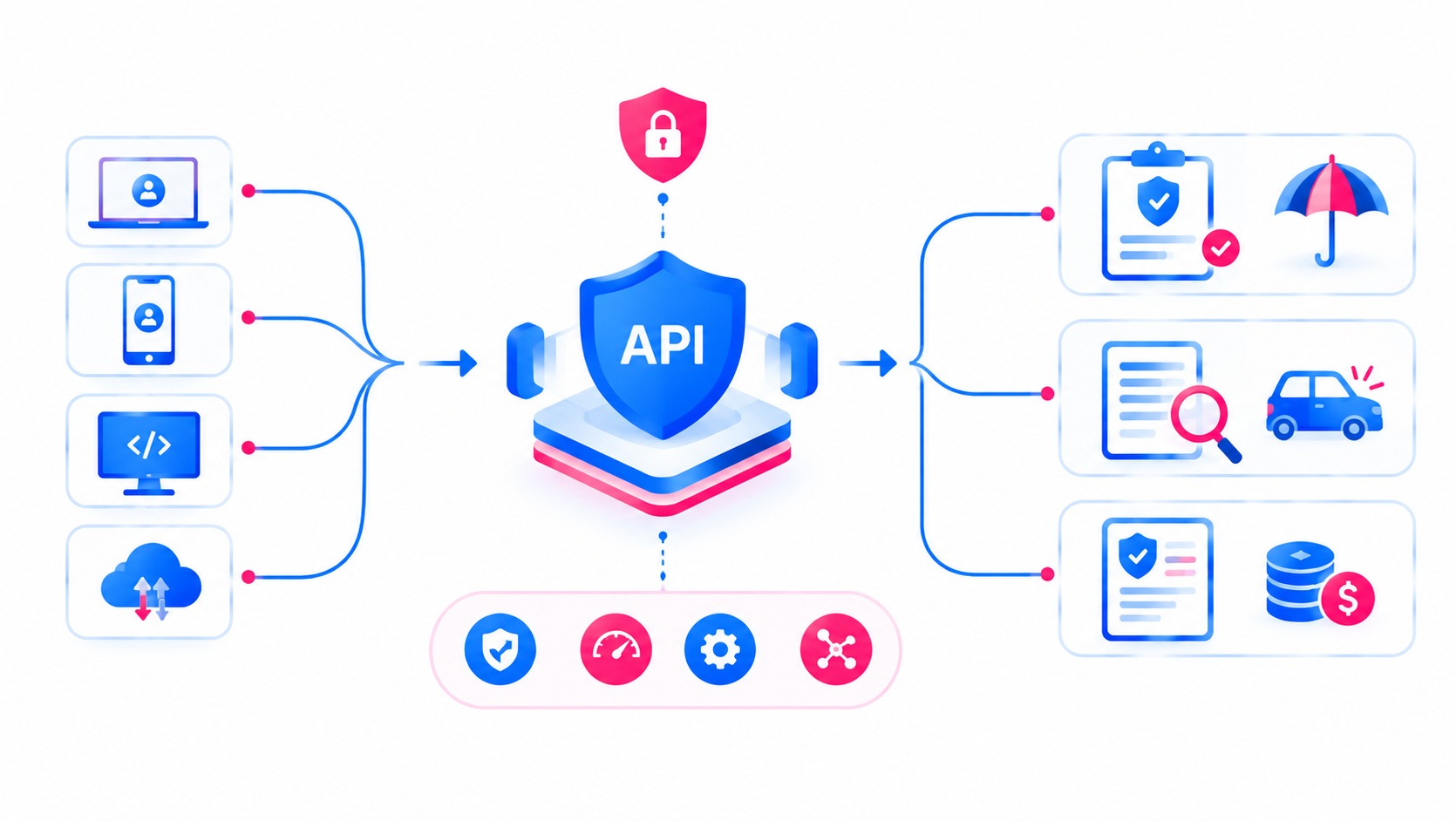
Every quote request, claim submission, and policy lookup passes through a door. If that door is poorly designed, it either slows the business down or lets the wrong people in. An API gateway for insurance is that door, and as underwriting and claims systems open up to partners, apps, and AI agents, designing it well has become one of the most important security decisions an insurer makes.
Why Insurance Needs a Dedicated Gateway
Insurance platforms expose some of the most sensitive data in any industry: health details, financial records, personal identifiers, and claims histories. At the same time, insurers are connecting to more outside parties than ever, including brokers, embedded insurance partners, comparison sites, repair networks, and third-party data providers.
Without a central control point, each integration becomes its own security decision. Authentication gets implemented differently across services, logging is inconsistent, and a vulnerability in one endpoint can expose data from another. An API gateway for insurance solves this by placing a single, governed entry point in front of backend systems, so security, traffic, and monitoring rules are applied consistently rather than reinvented for every connection.
What an API Gateway Actually Does
A gateway sits between API consumers and the services behind it. It receives each request, checks it against policy, routes it to the right backend, and returns the response. Along the way, it can handle authentication, authorization, rate limiting, request validation, logging, and transformation.
Think of it as a trained receptionist for your systems. It verifies who is calling, confirms they’re allowed to ask for what they’re requesting, checks the request is well-formed, and keeps a record of the visit. Backend services can then focus on business logic rather than repeating the same security checks in every codebase.
Securing Underwriting Endpoints
Underwriting endpoints handle quote requests, risk data, pricing, and eligibility decisions. They face two distinct threats: data exposure and abuse.
Protecting sensitive inputs and outputs. Underwriting requests often contain personal and financial details. The gateway should enforce encrypted connections, validate request structure, and reject malformed or unexpected data before it reaches the rating engine.
Preventing scraping and rate abuse. Quote APIs are attractive targets for competitors and bad actors who want to reverse-engineer pricing or harvest data by sending thousands of requests. Rate limiting, quotas, and anomaly detection at the gateway help detect and block this behavior without affecting legitimate partners.
Controlling what each partner can see. A broker may be allowed to request quotes for certain products only, or see limited rating detail. The gateway can enforce these entitlements per consumer so that access matches the business agreement.
Securing Claims Endpoints
Claims endpoints carry different risks. They accept documents, photos, and statements, and they expose claim status, payment details, and medical or financial information.
Safe handling of uploads. File uploads are a common attack route. The gateway can enforce size limits and file type restrictions, and route files to scanning services before they reach internal systems.
Strict object-level authorization. One of the most common API vulnerabilities is allowing a user to access another person’s record by changing an identifier in a request. Claims endpoints must verify that the authenticated caller is entitled to the specific claim being requested, not just that they are logged in.
Protecting payment-related actions. Any endpoint that triggers or modifies payments deserves stronger controls, such as step-up authentication, additional approval flows, and detailed logging.
Core Security Capabilities to Build In
Regardless of the endpoint, a well-designed API gateway for insurance should include several foundational capabilities:
- Strong authentication. Use modern standards such as OAuth 2.0 and OpenID Connect, with short-lived tokens rather than long-lived keys. Mutual TLS suits high-trust partner connections.
- Fine-grained authorization. Apply role-based and attribute-based rules so access reflects who the caller is, what they’re doing, and what data is involved.
- Rate limiting and throttling. Protect backend systems from overload and abuse, with different limits per consumer and per endpoint.
- Input validation. Check requests against defined schemas to block injection attempts and malformed data.
- Encryption. Protect data in transit, and ensure sensitive fields are handled carefully in logs.
- Threat detection. Monitor for unusual patterns, such as sudden spikes, repeated failures, or access from unexpected locations.
Governance, Logging, and Compliance
In a regulated industry, being able to prove what happened matters as much as preventing problems. The gateway is a natural place to capture an audit trail: who called which API, when, with what outcome. Logs should be detailed enough for investigations but careful not to store sensitive data unnecessarily, so masking and retention policies matter.
The gateway also supports API lifecycle management. Versioning lets insurers update endpoints without breaking partners, and a developer portal with clear documentation helps consumers integrate correctly. Consistent standards across APIs reduce errors and make compliance reviews more manageable.
Preparing for AI Agents and Automation
As insurers adopt AI agents that call APIs on behalf of users, the gateway becomes even more important. Agents can generate requests dynamically, at speed and volume, and may behave unexpectedly if manipulated. Gateway-level controls, such as scoped credentials, per-agent rate limits, and restrictions on high-risk actions, provide a safety boundary independent of the agent’s own reasoning. High-impact operations, like approving payments or changing coverage, can require additional verification or human approval.
Design Choices that Matter
A few architectural decisions shape how well a gateway performs:
- Centralized vs. distributed. A single gateway simplifies governance, while multiple gateways can separate internal, partner, and public traffic. Many insurers use a layered approach.
- Performance. Security checks add latency, so the gateway must be designed to scale, especially for quote flows where speed affects conversion.
- Resilience. Build in failover, caching where appropriate, and graceful handling of backend outages.
- Observability. Dashboards and alerts should make traffic patterns, errors, and threats visible in real time.
Conclusion
A well-designed API gateway for insurance gives underwriting and claims endpoints a consistent, secure front door, one that protects sensitive data without slowing legitimate business. Insurers that invest in strong authentication, granular authorization, and thorough monitoring will be able to open their platforms to partners and AI with confidence.


