

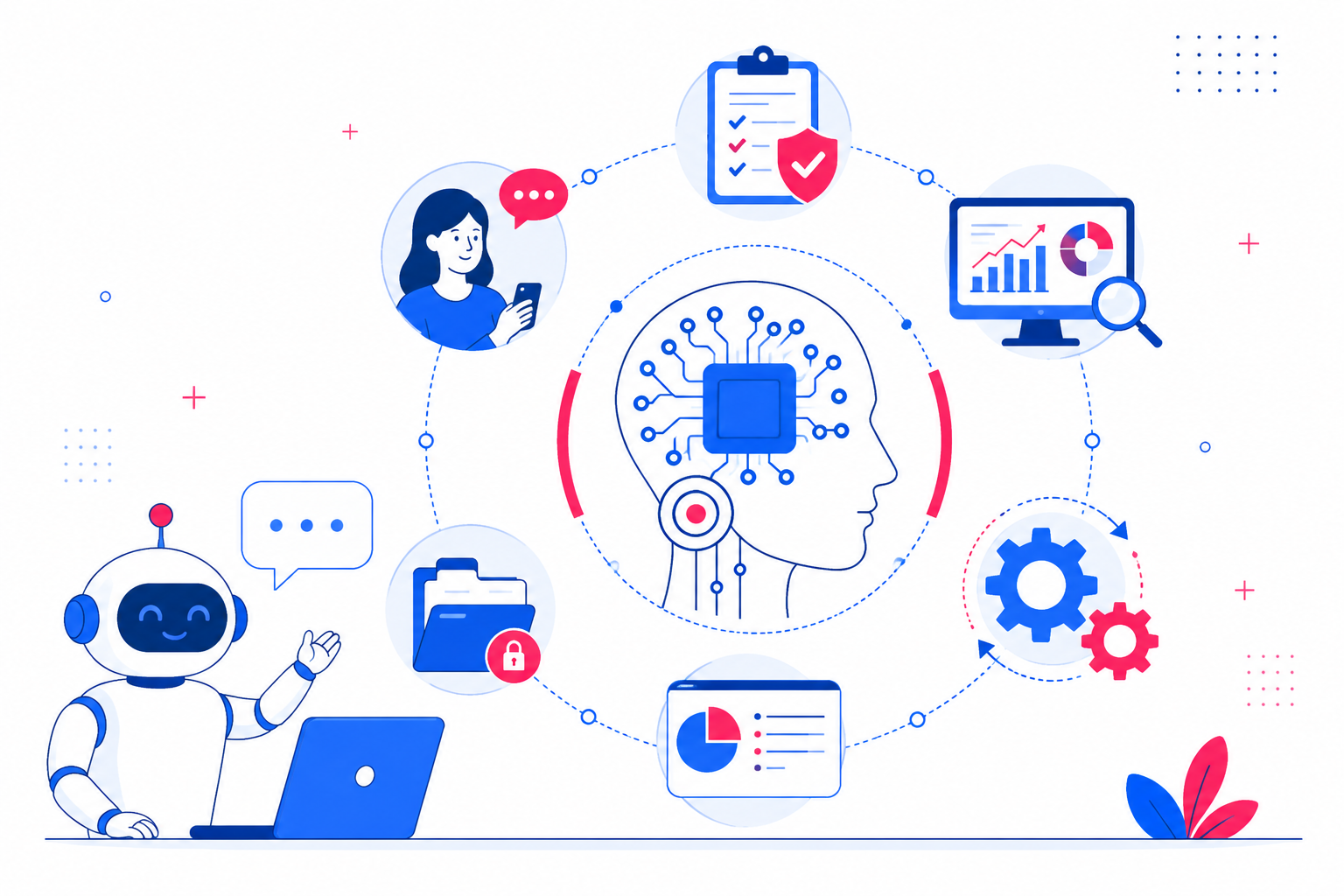
When most people think of AI in insurance, they think of a chatbot that answers questions about a policy or assists with filing a claim. Chatbots are the most visible face of automation in this industry, so that’s a full picture. Yet concentrating solely on customer-facing tools misses most of the visible face of automation in this industry. However, if we only look at the customer facing tools, we miss significantly the trends that would provoke the actual transformation happening right now. Deloitte’s Global Insurance Outlook 2026 highlighted that, Property and Casualty insurers deploying AI-driven, real-time fraud analytics could save up to $160 million by 2032. This highlights what most of the policyholders are on what they never see; the real shift is happening in underwriting desks, claims departments, compliance teams and the actuarial models.
Behind the scenes is where the real work is done
Documents still support all insurance companies. Applications, medical records, inspection reports, adjuster notes, and policy contracts all add up to a mountain of administrative overload. This was slow, manual, heavy, expensive document work for decades. But AI models can today read a submission, compare it to the underwriting guidelines, and flag the inconsistencies within minutes, not days.
Generally, the pipeline starting point is the ingestion of documents. The OCR turns the scanned PDFs and the handwritten forms into machine-readable texts, and a named entity recognition layer that extracts the fields that really matter. This includes the applicant’s age, coverage limits, previous claims history, and square footage of property. The extracted data is then passed to a rules engineer or classification model, which checks it against the underwriting appetite.
The deeper layer
This isn’t an AI chatbot answering a customer’s query. No, it’s a system quietly parsing thousands of pages of underwriting appetites. This is not just an AI chatbot replying to a customer. Instead, it’s about pulling the right data points and routing files to the right desk based on the complexity score.
The old operational landscape looks more manually heavy. Manually comparing an applicant’s current policy against a standard form. This is exactly why a change was highly anticipated. Today, a retrieval augmented model can index both the documents, run a clause-by-clause comparison, and surface the coverage gaps or price the discrepancies in just a matter of seconds. The retrieval augmentation matters here, and specifically, because underwriting guidelines change constantly, and a model that references live policy documents instead of relying solely upon what it learned during training produces far fewer outdated or incorrect flags.
Customer satisfaction during claims processing
The claims departments have arguably seen some of the deepest changes, and much of it happens invisibly to the policyholder. However, when someone submits a claim, they might be interacting with an app or short online form, nothing which looks specifically futuristic. However, behind that simple interface, machine learning models are classifying the claim by risk and complexity. Deciding whether it can be settled instantly requires a light review or a complete investigation.
The claims departments have arguably seen some of the deepest changes, and much of it happens invisibly to the policyholder. However, when someone submits a claim, they might be interacting with an app or short online form, nothing which looks specifically futuristic. However, behind that simple interface, machine learning models are classifying the claim by risk and complexity. Deciding whether it can be settled instantly requires a light review or a complete investigation.
This triage step is exactly where a lot of cost savings in the industry are coming from. Straight out of processing, means claims resolved without any human touch, has climbed sharply at the insurers who have invested in this kind of automation. The classification model itself is typically trained onto years of historical claims data, weighing multiple features like loss type, claimed amount, policy tenure, and prior claims frequency output a confidence score. Claims above a set threshold route straight to payout, however, anything that goes below it significantly escalates to the human adjuster, which would often be with the model’s reasoning attached so that the adjuster isn’t starting from zero.
For property and auto claims specifically, the computer vision models have added another layer completely. A policyholder would be uploading photos of vehicle damage or a flooded basement, and an image recognition model estimates the repair cost by comparing the damage against a labeled dataset of prior claims photos. This significantly cuts the weight for a physical inspection team on straightforward cases, while most of the insurers still route higher value or ambiguous damage to a human appraiser as a check. None of this essentially depends on a chatbot. Instead, it depends on models that are trained to recognize patterns across enormous volumes of historical claims data and apply that judgement consistently every time a new claim arrives.
Why this matters more than the chatbot conversation
The industry is obsessed with customers facing AI chatbot tools that are becoming a core part of the insurance operational infrastructure. With its robust use case across multiple insurance functions, such as underwriting automation, fraud detection, claims triage, and compliance reporting, it doesn’t generally generate flashy headlines. However, they are truly reshaping the cost structures and speeding up decisions across the entire business.
This distinction truly matters for anyone who is evaluating insurance technology, whether they are an executive building a roadmap or a policyholder who is curious about the way their claims get processed so quickly. The visible layer, a friendly chat window, or a mobile app is just the surface. Underneath it sits a growing infrastructure of models, which quietly makes decisions that essentially require extreme amounts of manual review.
Where this is heading
The next phase of insurance looks less like isolated tools and more like connected systems working across the whole policy lifecycle. The underwriting models feed data to the claims systems through shared APIs, claims outcomes feed back into fraud detection engines, fraud signals inform pricing, and the risk assessment models would further upstream. To make this work reliably, there is a requirement of a layer that most people do not hear about.