

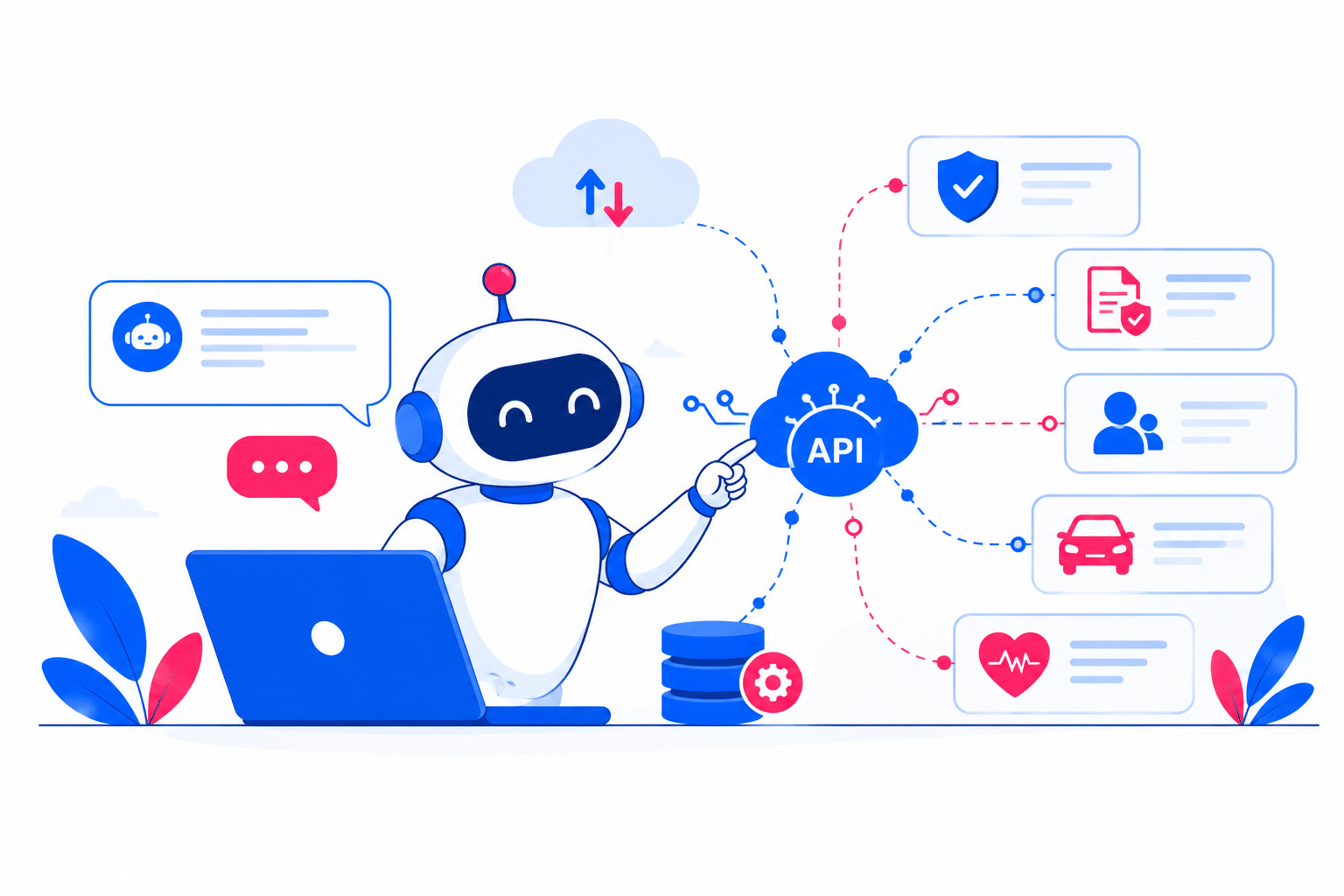
The AI agents can independently check a policy, file a claim, and even pull a quote, which no longer works as the research demo. Instead, they are moving into production across the insurance industry. However, an agent that can reason well is only half the equation. The other half remains the API layer which is designed carefully enough for that agent to act safely, accurately, and within clear boundaries. This is exactly what is pushing the insurers to get this design right fast and also define the technical challenges in modern insurance technology.
Why do the AI agents need a different kind of API design?
The traditional APIs were specifically built for the predictable callers, like the front-end application, a partner’s backend system, and a scheduled batch job. These callers follow fixed, well-tested request patterns. The AI agents behave differently. They construct the API calls dynamically on the basis of reasoning the user’s requests. This means having the same underlying API might be called in ways its original designers never explicitly anticipated.
This changes the design priorities. An API that is built for a human developer to integrate once can afford some ambiguity, because that developer can read documentation, test the edge cases, and ask questions. An API will be meant to be called autonomously by an AI agent who needs to be unambiguous by design. This includes clear parameter names, predictable response structures, and explicit error messages that the agent can actually reason and recover from, instead of having a vague failure that leaves it stuck.
Authentication and authorization for autonomous callers
The security design is shifting significantly when the caller is an autonomous agent instead of a human logging into the session. An AI agent will be acting on behalf of the policyholder’s needs and credentials that will be scoped precisely to what the specific interaction should allow. This is enough to check that the policyholder needs credentials that have scoped precisely to what the specific interaction should allow.
This also requires moving beyond the broad API keys towards fine-grained, context-aware authorization. Most of the insurers are adopting the token-based systems where each of the agent sessions carries a scoped credential tied to a specific user, a specific task, and a defined time window. This significantly limits the blast radius if an agent behaves unexpectedly or if a malicious actor attempts to manipulate an agent into making unauthorized calls. Given how sensitive the insurance data is, this is not an optional hardening step. Instead, it’s about being foundational to deploying the agents responsibly at all.
Building the guardrails around agent actions
Not every action an AI agent could technically perform through an insurance API should happen without having human oversight. Checking a policy’s coverage details is quite low risk and well-suited to full agent autonomy. Approving a claims payout or modifying the policy terms carries far more consequence, and most of the insurers are, appropriately, keeping a human in the loop for actions at that level, at least for now.
The effective agent design draws this line explicitly at the API layer, not just in the agent’s own logic. Read-only, low-risk endpoints can be exposed for full agent autonomy. The higher stake endpoints can be designed to require an additional confirmation step, generate a pending action for human review, or simply remain outside the agent’s available toolset entirely. Building these guardrails into the API itself, instead of just trusting the agent’s reasoning alone to respect them. This essentially creates a more reliable safety boundary than relying purely on the prompt instruction, which the agents can misinterpret or fail to follow under the unusual conditions.
Testing agents against the real API behavior and not just happy paths
A common mistake in the early agent deployments is testing almost exclusively against the ideal scenarios. This includes a straightforward claims status check and a simple quote request. The production insurance environments are far messier, and the agents need to be tested on the full range of API behavior. This also includes the rate limits, partial outages, unexpected response formats, and genuinely ambiguous user requests that do not map cleanly to any single API call.
The insurers who are building robust agent deployments will be investing heavily in this kind of adversarial and edge case testing before launch. This is specifically because the agent failures in production tend to be harder to diagnose than the traditional software bugs. This additionally includes the fact that the agent’s reasoning isn’t always obvious by just looking at the final output.
What’s ahead?
Designing AI agents that work reliably with the insurance APIs comes down to the API design itself. This includes having a clear structure, scoped authentication, deliberate guardrails, and graceful error handling.