

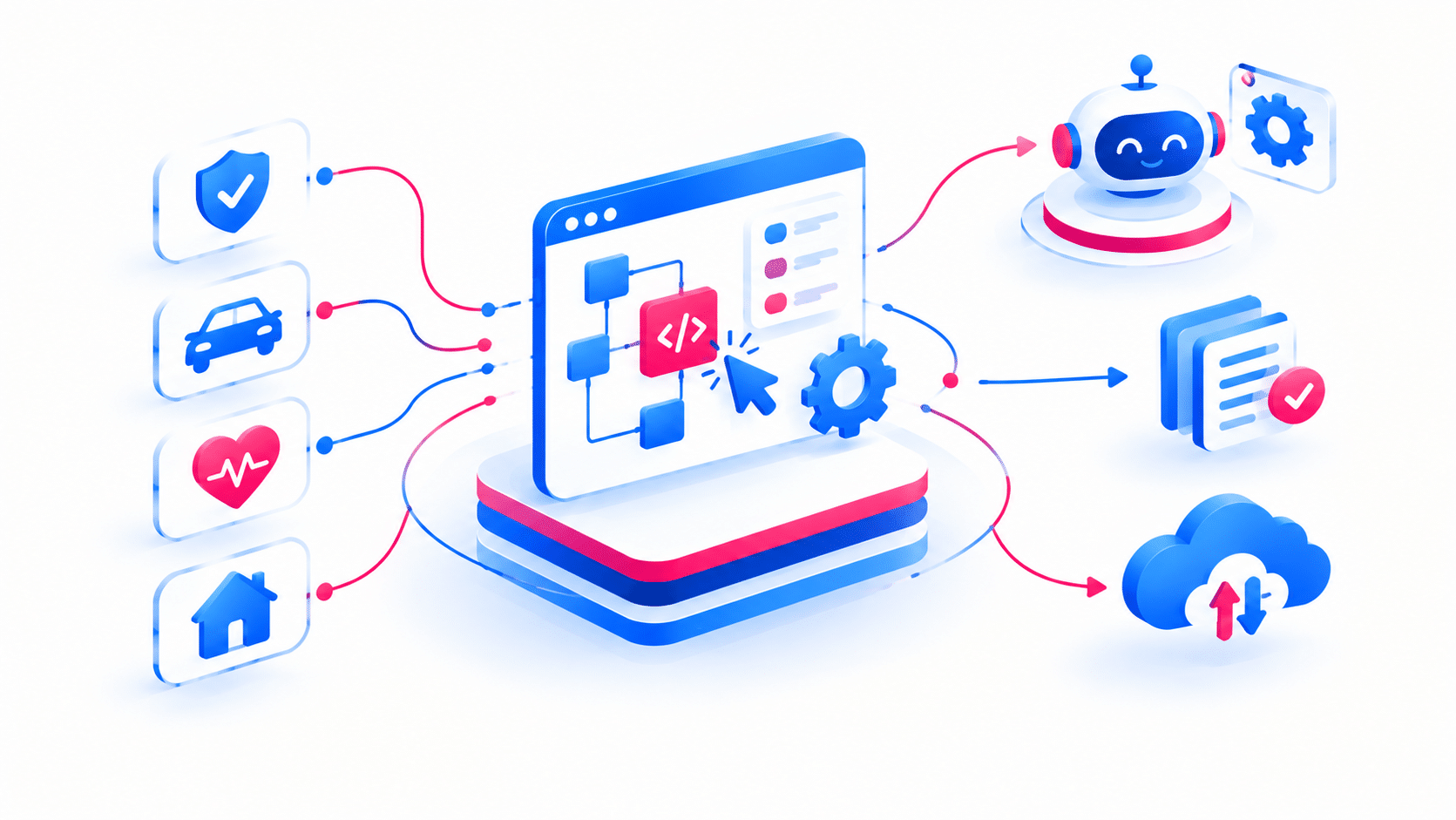
Hyper automation has become one of the most talked-about shifts in insurance technology, and low-code is quietly doing much of the heavy lifting behind it. As the carriers race to automate everything from the underwriting to claims, however, the question here is not to automate; instead, it’s about how to do it without rebuilding the entire technology stack right from scratch.
What hyper automation actually means for insurance
Hyperautomation is not just a single tool; instead, it’s a strategy. It specifically refers to the combination of multiple technologies, and that includes robotic process automation, artificial intelligence, machine learning, and business process management followed by workflow orchestration. This is working together to automate as many business processes as possible, and that too intelligently.
For insurance specifically, this means having to go beyond the isolated automation towards a connected automation across the full policy and the claims lifecycle. This includes the intake, underwriting, risk assessment, claims adjudication, payments, and customer communication. All these are working as one coordinated system instead of disconnected point solutions.
While the ambition is quite big here, the execution is even bigger. Insurance carriers specifically run on decades-old core systems that are layered with newer platforms bolted over time. The hyperautomation strategies that assume a clean, modern tech stack will often be stalled at the moment where they meet the real-world insurance infrastructure.
This is exactly where the low-code conversation will enter the same, not as a replacement but for a custom development, but as the practical bridge that makes hyperautomation achievable within legacy-heavy environments.
Why low code is gaining ground in insurance
The low-code platforms will let teams build applications, automate workflows, and connect systems using visual interfaces and prebuilt components instead of writing extensive custom code line by line. For an industry that is constantly under pressure to modernize quickly, with limited engineering bandwidth, that speed advantage is quite significant.
A few of the reasons why low code has moved from ‘nice-to-have’ to a core part of many insurance technology roadmaps include:
Speed to deployment
The traditional core system changes in insurance can take months or years. Additionally, the low-code tools will be compressing their timeline dramatically, allowing the business and the IT teams to launch automated workflows in weeks instead of quarters.
Lower dependency on scarce engineering talent
The insurance IT teams are often stretched thin in maintaining the legacy systems. The low-code and no-code platforms will be allowing the business analysts, operations teams, and citizen developers who will be able to build and adjust the workflows directly. Thus, freeing engineering resources for more complex and high-value work.
Easier integration with legacy core
Most of the low-code platforms are purpose-built with the connectors for common insurance ecosystems, policy administration platforms, and the claims management tools. This makes it quite easier to automate around legacy infrastructure instead of replacing it outright.
Fast iteration
The insurance processes change drastically and also constantly. With newer regulations, new products, and new risk models coming in. The low code environments make it realistic to adjust a workflow in days instead of initiating a full development cycle every time a process needs to change.
Where low code fits in the hyperautomation stack
Low code is not an entire hyperautomation stack; instead, it’s one of the most critical layers within it. Thus, understanding where it helps the insurers avoid both over-relying and also underusing it.
The orchestration and workflow layer
This is exactly where low code shines the brightest. Thus, helping in connecting the disparate systems, defining business rules, and automating the multiple-step processes. This is just like routing a claim or triggering an underwriting review and is exactly the kind of work that low code platforms are specifically designed for.
The integration layer
The low-code tools often come with the pre-built connectors and the APIs that link the core insurance systems with newer cloud-based tools. This helps in significantly reducing the custom integration work that used to consume months of development time.
The user interface and experience layer
Building the internal tools, agent portals, or just the simple customer-facing forms is one of the simplest and also another natural fit. Thus, low-code dramatically speeds up the interface development without sacrificing usability.
Where low code is not the right tool
It is worth being direct about the limitations. The high-complexity, performance-critical systems include the core underwriting engines, actuarial modelling, or the systems that require deep customization. This generally still requires an additional development.
In addition to this, the hyperautomation strategies that try to force every layer into low code often run into scalability or the flexibility walls later.
Building a realistic hyperautomation strategy with low code
The insurers who are getting the real value from hyperautomation tend to specifically follow a few consistent principles:
Start with the process and not the technology
Mapping the existing workflows and identifying the genuine bottlenecks before choosing the tools. Thus, automating a bad process will just create much faster bad outcomes.
Treating low-code as a layer and not a strategy
It is a powerful accelerant within a much broader hyperautomation approach and not just a standalone solution for every automation need.
Involving both business and IT teams
The biggest advantage of having a low-code platform is enabling business users to build and adapt the workflows directly. However, governance and oversight from IT still matter to avoid fragmented, unmanaged tools that will be sprawling across the organization.
Prioritizing the integration capability
Since most of the insurance environments are a mix of legacy and modern systems. Thus, choosing the low code tools with strong, proven connectors to the existing core platforms.
Measuring outcomes and not adoption
This includes tracking the cycle time reduction, error rates, and cost savings. This is exactly how most of the workflows are not built. Additionally, low-code success is measured in business impact and not just tool usage.
Conclusion
Hyperautomation is all about reshaping the way insurance operates, and low-code platforms have truly earned their place as a core enabler, not just a whole solution. This is used deliberately as the orchestration and integration layer within a broader stack; low code lets insurers automate faster, offer quick adoption, and modernize without ripping out the legacy systems that they depend on.