

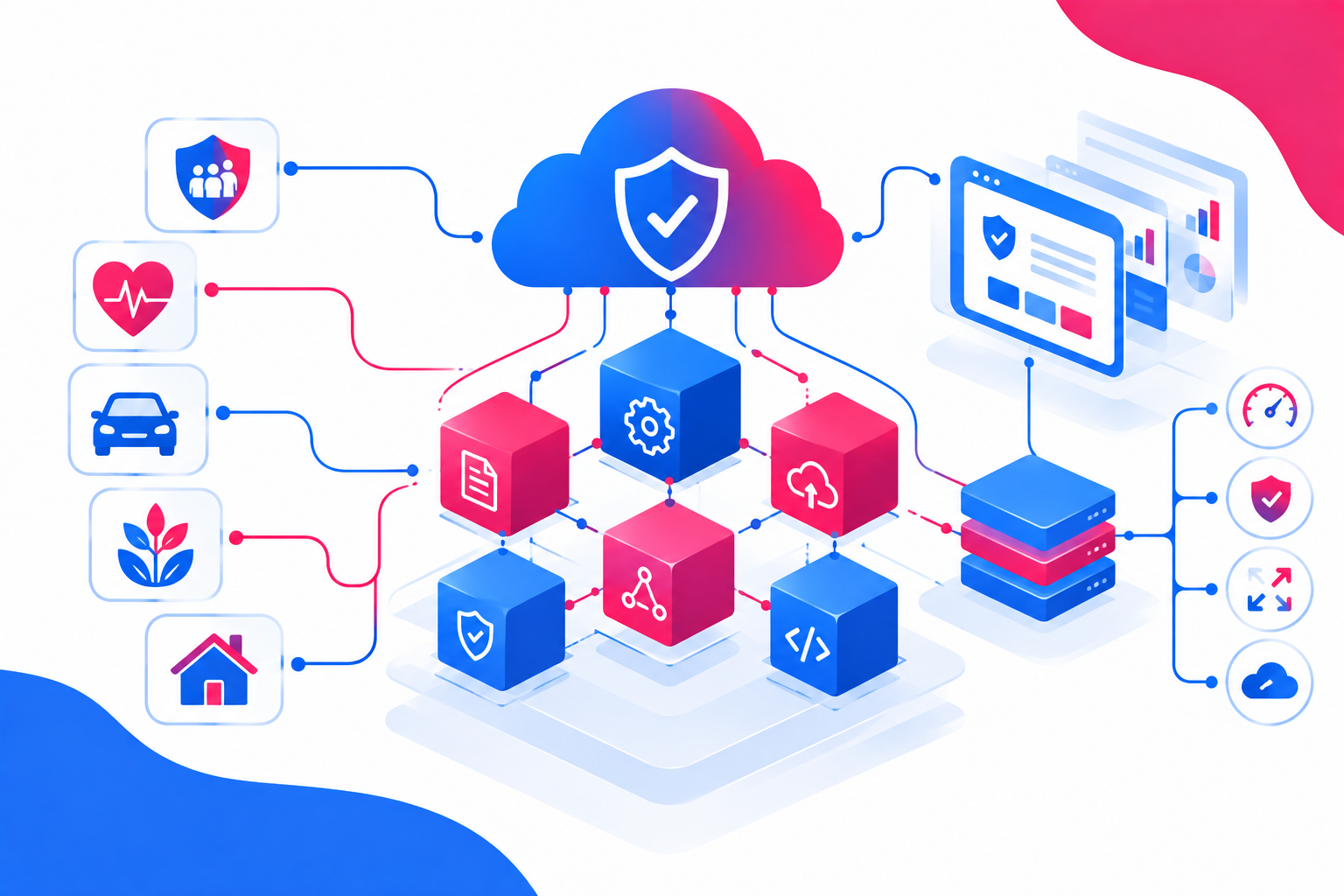
Imagine having to shut down your entire Policy system only for you to change one premium and the way it’s calculated. For most of the insurers, that is still the reality. The microservices break that dependency heavily by splitting large systems into much smaller, independent services, which are built, scaled, and updated on their own. This is quite an architectural shift, but it’s fast becoming the backbone of modern insurance technology.
What are microservices?
A microservices architecture specifically breaks down a large application into a collection of small, independently deployable services, which includes each being responsible for a specific business function. In the industry, that might mean separate services for quoting, underwriting rules, policy issuance, billing, document generation, and claims intake, all communicating with each other through some well-defined boundaries.
The contrast with a traditional monolith is quite stark. In a legacy system, these are the functions that are tightly interwoven within one codebase. Updating the billing logic would be unintentionally affecting the underwriting behavior, so every change demands extensive regression testing across the platform. With microservices, each of the functions will be updated, tested, and deployed on its own, without touching the rest of the system.
Why legacy systems are struggling in Modern Insurance
The legacy systems were built for a different era. When the products changed slowly and distribution ran through a handful of channels, a single integrated system will be making much more sense here. Today, the insurers are launching new products much faster, integrating with more partners, and also handling unpredictable spikes in the transaction volume.
Under those conditions, the legacy systems had become a complete drag. Thus, scaling a single component like quote generation during a busy renewal season means essentially scaling the entire application, which is wasteful and also quite expensive. If a bug in one module can cascade across multiple unrelated functions. The release cycles will be stretching into months, as every change will be carrying a system-wide risk. These are the structural limits of the architecture itself, which is exactly why so many reinsurers are rethinking their foundations instead of just patching them.
Independent scaling and targeted resilience
One of the most tangible advantages is essentially the ability to scale individual functions, which will be based on the actual demand. If a marketing campaign drives a surge in the quote requests, only the quoting service needs additional capacity. This specific billing, claims, and document service can keep running at its normal footprint.
Resilience improves in a similar way. In a well-designed microservices environment, a failure in one service does not automatically bring down the others. Instead, if the document generation service is a problem, then the policyholders will be getting the quotes and will be filing the claims while the engineers focus on fixing the issue. For the insurers, where downtime directly affects the customer trust and revenue, this is the kind of fault isolation that is a meaningful operational upgrade over the all-or-nothing failure modes of the monolithic platforms.
How Microservices will be working with the Low Code No Code Platforms
The microservices will be pairing up especially well with the low-code and no-code platforms, and the combination is exactly where a lot of reinsurers will be finding the real leverage. Additionally, a microservices architecture will be exposing clean, well-defined capabilities. These include a rating service or a document service, which can be consumed by other tools. The low-code/no-code environments can then use those services as the building blocks, letting the business teams assemble new workflows and customer experiences without writing the backend logic from scratch.
The division of labor is quite sensible here. The engineering teams will be building and maintaining the robust, secure services underneath, while the business users easily configure the way these services combine to support a specific product or process. Without a solid microservices foundation, the low-code/no-code tools would often end up constrained by the limits of a rigid core system. With it, they will be drawing on flexible, reusable components, which makes the whole approach even more powerful and much more maintainable.
The challenges that the insurers should not ignore
The microservices are not a free upgrade. Hence, disturbing a system across many small services will be introducing complexity that the legacy systems will not have. However, the teams have to manage communication between services, monitor the dozens of moving parts, and troubleshoot problems, which would span instead of living in a single codebase. However, without strong observational tooling, diagnosing an issue can easily feel like searching for a needle across many haystacks.
Data management is getting harder as well. In legacy systems, data typically lives in one place. Additionally, in a microservices environment, each of the services may own its own data. This raises questions about consistency, especially for the insurance workflows where accuracy becomes non-negotiable.
The security surface area also grows, since every service-to-service connection will be a potential point of exposure that specifically needs to be governed. Additionally, the insurers who adopt the microservices successfully will be investing in these foundations early, treating monitoring, data governance, and security as design requirements instead of cleaning up tasks.
Moving from Legacy Systems to Insurance Policy Admin Systems
There are very few insurers who want to get started from a blank slate, and a full rewrite of a core system is rarely realistic. This is the most common and lower-risk approach that is gradually decomposing, and this includes identifying a well-bounded function that includes document generation or a specific rating calculation and extracting it as an independent service while the legacy system will continue to run everything else.
What’s ahead?
The microservices will be giving the insurers modularity, scalability, and resilience that the legacy systems cannot match, and thereby, they will create a flexible foundation on which the low-code and no-code tools and rapid product innovation will depend. The insurers who adopt them incrementally and invest in the operational discipline that they require are essentially building insurance technology that can keep pace with the market, which can stand still.