

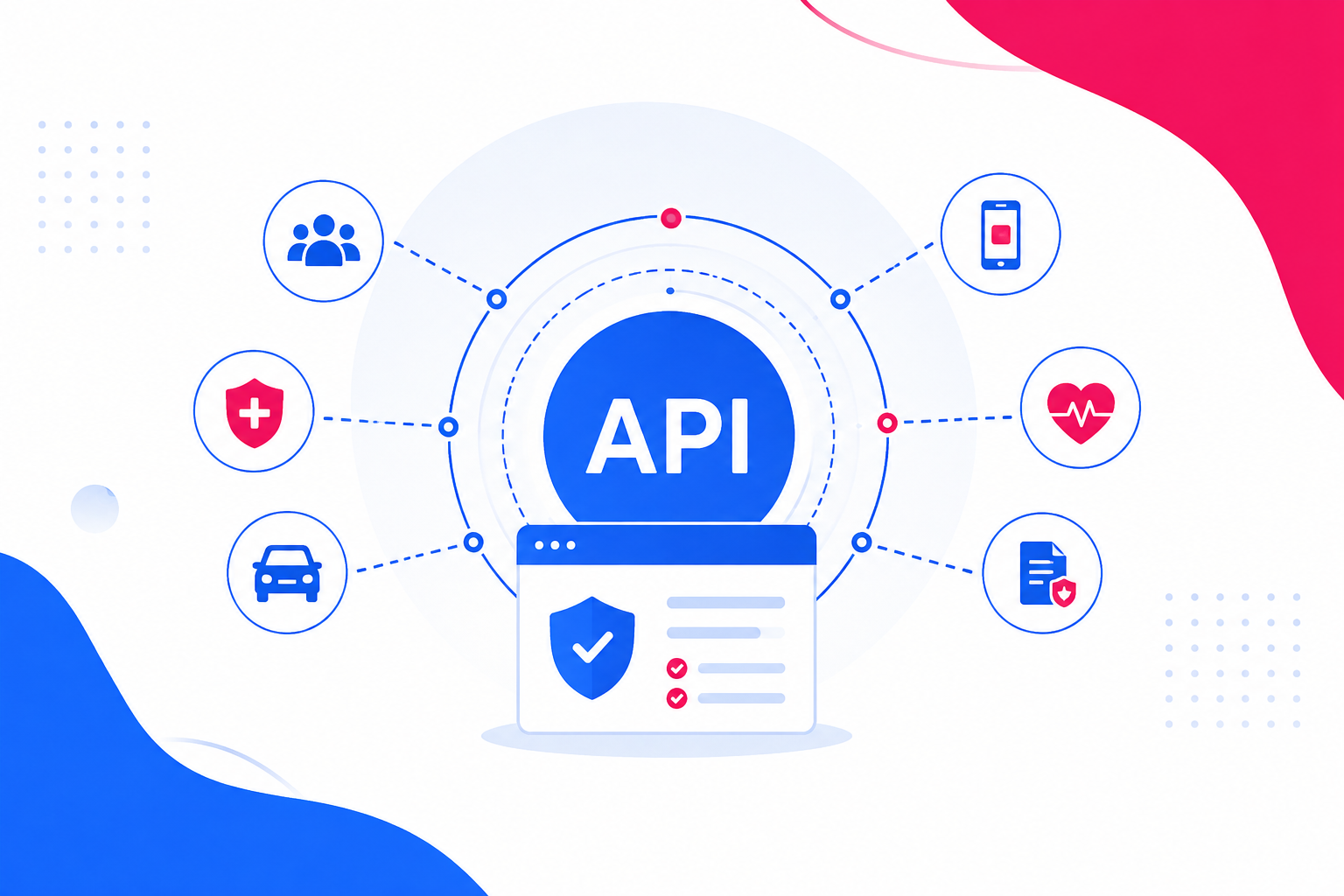
Insurance is an industry that specifically runs on data, and that includes policies, claims, underwriting rules, and risk scores. For decades, the data has lived in rigid and siloed core systems, which were hard to connect to anything new. This is exactly where a different approach needs to be taken over, and this has an API architecture where every capability that a platform offers quoting, underwriting, claims, and billing. It is built and exposed as a modular, callable service right from day one, instead of having it bolted on later. This shift is not a trend; instead, it’s becoming the baseline expectation for how modern insurance platforms are built.
What does “API first” actually translate to?
In simple terms, API-first means instead of building one giant, tightly locked system and adding integrations later, an API-first platform is essentially designed around its APIs, right from the start. Each and every function, including issuing a quote, pulling a credit report, and filing a claim, will be a discrete, well-documented service that the other systems can plug into.
Think of it like electrical outlets in a house. You do not have to rewire your walls every time you buy a new appliance; all you need to do is to just plug in. The API-first platforms will be giving the insurers that same plug-and-play flexibility for software.
Why this is replacing the old model
The legacy core insurance models were built as monoliths, which includes everything from policy issuance to billing, living in one tightly coupled codebase. This makes a single change quite crucial and makes an impact on the whole system; this is slow, expensive, and quite risky.
Here are the top three forces that are pushing the insurers away from this model:
Speed to market
Earlier, launching a new product into the market would take 12-18 months. However, with the modular, API-based components, the insurers will be able to assemble the new products, including Parametric travel insurance, usage-based auto, and embedded coverage at checkout. This is done in weeks by recombining the existing services, instead of completely rebuilding from scratch.
Ecosystem integration
The modern insurance industry does not operate in isolation. Distribution partners, comparison sites, MGAs, reinsurers, and other operational stakeholders would all need to exchange data continuously. With APIs, this arrangement becomes much more standardized and secure. Instead of requiring a custom point-to-point integration for every partner.
Customer expectations
The policyholders expect instant quotes, real-time claims status, and the self-service portals. This is the same response that they would get from their ride-sharing or banking apps. This same responsiveness is only possible when the backend will be serving data in real-time through APIs, instead of batching overnight processes.
The technical backbone- what the insurers should look for
For the architects who are evaluating a platform, a genuinely API-first system typically includes:
Comprehensive API documentation
This includes OpenAPI specs, sandbox environments, and versioning policies
Idempotent endpoints
This is specifically for safe retries in payment and claims transactions.
OAuth 2.0/OpenID Connect
For securing role-based access control across partner integrations
Webhooks
This is specifically for the asynchronous event notifications, and this includes claim status changes.
Rate limiting and API gateways
This includes Kong or AWS API Gateway to specifically manage traffic and enforce SLAs.
Sandbox-to production parity
A sandbox to production parity empowers the partners to test integrations without touching the live policyholder data.
The real-world impact
The shift to having an API-first architecture isn’t just theoretical; instead, it’s already reshaping the way insurance gets built and sold.
Embedded insurance is the clearest proof point
The coverage, which is sold at the point of need, includes travel protection at checkout, followed by device insurance on a phone purchase, and more such everyday purchase moments. All these depend entirely on the quote, issue, and binding a policy in real time. This will no longer be a side experiment.
The Embedded Insurance market is projected to grow roughly from $145 billion in 2025 to over $1.2 trillion by 2033, with three-quarters of placements already flowing through digital, API-first channels.
The speed-to-market gains are measurable and not anecdotal
McKinsey research insurance IT modernization specifically highlights that the modern core platforms can enable real-time data access and faster product development cycles, helping insurers improve agility, underwriting effectiveness, and business performance.
The gap between ambition and execution lies in the opportunity
There are many surveys that suggest that most of these insurance executives consider API strategy as central to digital transformation, yet only a minority call their current program mature. The insurers who close that gap first get much earlier access to the distribution partners and embedded channels.
The peer-reviewed research on API-first adoption has also linked mature API programs to a much higher market valuation and also lowered the operational costs. This makes its way up on the balance sheets and not just the IT budgets.
Smooth claims experience can be the ultimate gamechanger
Straight through claims processing or a telematics signal or a repair shop API would automatically be triggering a workflow. This depends on the same event-driven backbone. A recent industry has highlighted that the customers rate insurers far more favorably when the status updates are continuous instead of requiring a call-in.
Bottom line
Having an API-first architecture isn’t just about having a technical preference; instead, its becoming a competitive necessity. The insurers who keep their core systems closed and monolithic will be struggling to launch products or meet the digital-first expectations. As the industry keeps moving towards embedded coverage and real-time updates in claims management, API-first will be the new standard that the laggards will be racing to catch up to.