

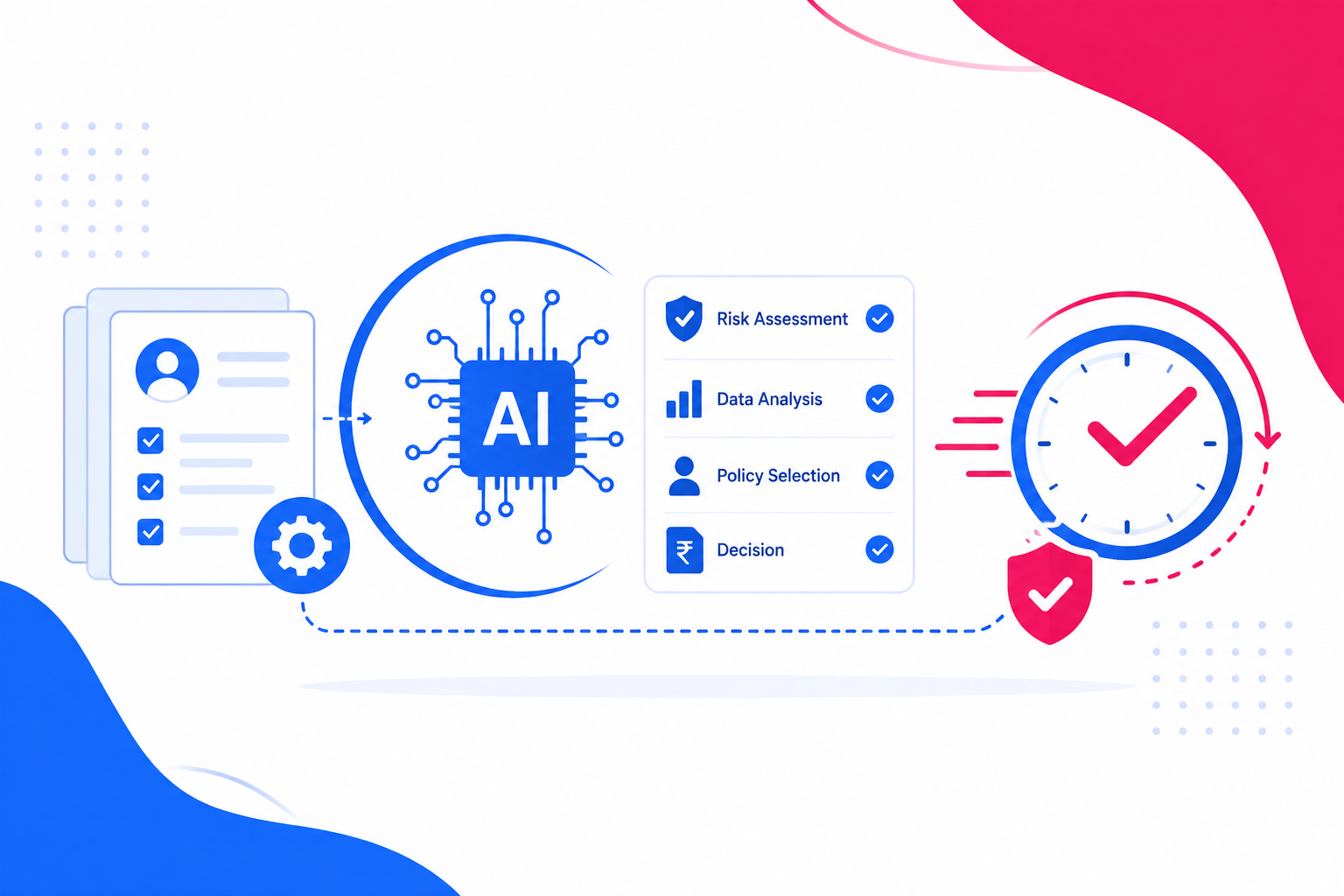
There is a quiet assumption that has been followed in the insurance industry for decades, and this includes speed and safety. It sits at the opposite ends of a scale, and moving one would often mean sacrificing the other. Faster underwriting has always been associated with loose underwriting and also faulty ones. This is the trade-off that is slowly looking to be a lot outdated. Underwriting is built around automation, and it is not fast because it cuts through the corners. Instead, it rapidly removes the corners, which never needed to exist. This is exactly where one needs to understand the difference between an insurer who automates recklessly and the ones who automate well.
The real source of delay is not rigor
Every underwriter spends a huge amount of time doing rigorous risk analysis. It simply means chasing down the missing documents. It’s re-keying the data that already exists somewhere in the system. It’s waiting on a manual review queue, which is quite straightforward, and it does not need to be there in the first place. Instead, it applies the same judgement all the time to assess the risk profiles, which are functionally identical to the ones reviewed a hundred times earlier.
None of these delays make underwriting faster; instead, it makes it much slower. This is the insight which is sitting underneath every meaningful insurance automation initiative. The goal here was not to underwrite faster by underwriting less carefully. This is was specifically to strip out the friction, which had nothing to do with careful judgement in the first place.
What automated underwriting actually changes
Automated underwriting does not remove human judgment from the equation; instead, it redeploys it. The rule-based engines and the predictive models essentially handle high-volume, low-complexity decisions that follow clear, consistent patterns. This is a standard auto policy for a low-risk driver, a straightforward renter as a policy, and a term life application from an applicant with no red flags in their history. These are the cases that get resolved in minutes instead of days, not because they get rushed but also because the pattern was well understood prior.
However, the cases that fit under a clean pattern include unusual risk combinations, high-value coverage, anything with genuine ambiguity, and still get routed to a human. This is the part that often gets lost in conversations about automation. It is a triage system that clears the obvious cases quickly; this is so because human attention gets concentrated exactly where it is needed.
This is exactly where AI fits into the picture.
Where AI comes into the picture
As operations become more complex, especially in underwriting, it’s important to bring the angle of AI into the picture. Today, AI is helping the underwriters to synthesize a far greater amount of data than a human reviewer could process in the same window, and this includes the credit signals, claims history, third-party risk databases, and even the unstructured data such as inspection photos or the medical records. This enables surfacing for a clearer and faster picture of the risk that lies ahead.
When done accurately, not only will the decision-making be sped up but also will help the underwriter to sharpen them. A model which is trained on years of claims outcomes can spot the correlations that a manual process would likely miss. Thus, flagging a risk factor that looks remarkable on the surface but has historically predicted trouble.
The discipline which keeps speed from becoming risk
Automation only holds up when it’s built up with the real guardrails, and this is exactly the part where the insurers can’t afford to treat it as an afterthought. A few of the principles that separate automation significantly reduce risk from automation that also plays a role in quietly increasing it.
The automated models need to be trained on data that is actually representative of the risks that are being underwritten and not a narrow historical slice that leaves the system blind to edge cases. They need clear, auditable escalation paths so that anything that is outside the model’s confidence gets kicked to a human reviewer than approved by default. And they would need constant ongoing monitoring, because a model that performed well two years ago can drift at the market conditions, fraud patterns, and the applicant’s behavior will be shifting underneath.
The insurers getting this right will be treating automated underwriting as a living system and not a set-it-and-forget-it tool. They will be auditing the outcomes regularly and will be keeping the humans in the loop for anything ambiguous, and they are honest about the model’s limitations instead of assuming speed is the proof of quality.
Turnaround time is the ultimate trust signal
It’s worth taking a step back and asking why the turnaround time essentially matters so much in the first place. It is not just about having an internal efficiency number; instead, it’s about one of the clearest signals that prompts a customer to understand the complexity of the operational processes of the insurer. A policy that takes weeks to underwrite sends an implicit message, and this is the process that is complicated.
What the insurers need to know
The conversation should not move to whether to automate underwriting. The harder and the more useful question is where the line will sit between the risk that’s safe to automate and the risk that still deserves a human’s full attention. This is the line that will be looking different for every insurer, every product, and every risk appetite.
Getting this right essentially requires resisting two temptations, which include the urge to automate everything because technology allows it followed by resisting automation in the current process because it feels safer. Neither of the instincts truly serve the customers or the business. What truly serves both is a genuinely deliberate approach, and this includes the one where speed is the byproduct of well-designed judgement and not a substitute for it.