

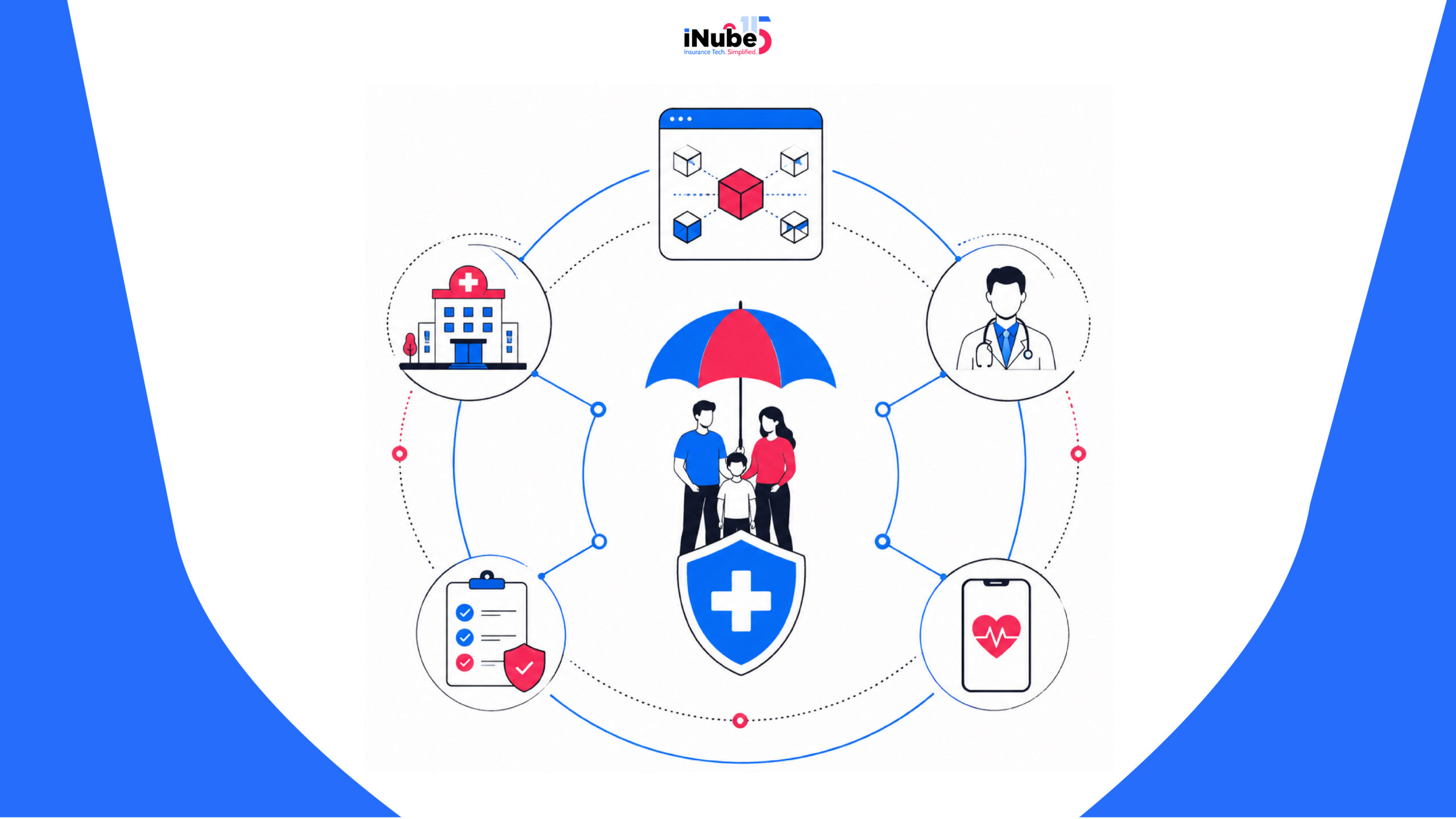
The most persistent challenge in Health insurance remains not the shortage of data or the lack of process. Instead, it’s the absence of a connection between the two.
The insurance technology providers who work closely with the health insurers, third-party administrators, and managed care organizations consistently identify the same root cause problem across their client base. Each of these organizations has claims systems, eligibility engines, provider data platforms, and benefit management tools. This is exactly where the low-code platforms have truly emerged as quite a practical answer to the problem. This article gives a brief understanding of how these low-code platforms can help build a connected health insurance ecosystem.
What exactly is a connected Health Insurance Ecosystem?
A modern Health insurance ecosystem typically extends far beyond claims processing. It typically connects multiple stakeholders, including insurers, members, health providers and the third-party administrators (TPAs), managed care organizations, provider networks, regulatory systems, and the payment platforms into a much more unified operating environment. Each of the participants would be generating and consuming information throughout the policy and the claims lifecycle.
What a connected Health insurance ecosystem actually involves?
A connected health insurance ecosystem isn’t something that is built by replacing the existing systems; instead, its done by orchestrating them. One thing that every CTO of an insurance company needs to understand is that the claims management systems, the provider data hub and the utilization management tools are not going away anywhere. Instead, the missing part remains the layer, which continues to sit across all of them, pulls the right information at the right time, and moves a claim through its lifecycle without having to require human intervention in bridging the gap between the systems.
When a connected ecosystem is in place, every touchpoint gets connected seamlessly. For instance, when a claim enters a connected ecosystem, the eligibility gets confirmed automatically against the live eligibility system. Here, the claim eligibility automatically gets mapped. With a rule engine at the back end, the claims eligibility gets predefined and validated against some specific set rules, and then the claim gets assigned to the respective claim adjuster. This is exactly where the difference between a collection of tools and having fragmented tools to do the process lies.
How does the approach need to deviate from the traditional technology implementation playbook?
The Health insurance operations are constantly evolving. With these changes underway, sticking to the traditional software development model, every change will be triggering a development cycle that would otherwise take weeks or months to complete.
The technology providers who have worked inside these environments will describe the consequences clearly. The compliance team will be managing the regulatory exceptions in spreadsheets as the system updates remain two sprints away. Additionally, the adjusters are applying for a manual workaround for contract terms which have not yet been reflected in the adjudication system. The operation managers will be tracking the claims status across multiple screens because no single view of the claim will exist.
Here, the main downside lies in the architectural level. This is exactly where technology that is designed to keep pace with the dynamic changes will be the one that will prove to be transformational. The low code platforms address all these at the architectural level. The adjudication rules, routing logic, communication triggers, and compliance controls will all be living in a more configurable workflow layer.
How can low-code platform architecture bring efficiency to the ecosystem?
A low-code platform essentially serves as the orchestration layer that essentially connects the existing Health insurance systems without any large-scale replacement projects. With the help of configurable workflows, business rules, APIs, integration services, and event-driven automation, the platform will be able to move information across the systems in real-time.
Instead of embedding the business logic inside multiple applications, the insurers can centrally configure the workflows, routing rules, communication triggers, compliance controls, and operational policies. This architectural approach will allow the organizations to respond to the regulatory changes, product updates, and operation requirements significantly faster than most of the traditional development cycles.
How do claims operations look like in a connected ecosystem?
In most of the Health insurance environments, before a connected ecosystem is in place, claim intake becomes passive. A typical claim arrives; it is logged, and it waits. This is exactly where the verification steps happen downstream, one at a time, often by the different people who are using different systems.
The technology providers will be implementing the low-code platforms to describe the shift that happens when the intake becomes more active. Right from the moment a claim is filed, the platform will be running the checks in the background. The eligibility gets confirmed at the date of service, and prior authorization records get pulled. In addition to this, the edit rules are applied, and the duplicate claims get raised, followed by the identification of the COB indicators.
Snapshot of an end-to-end connected journey
A connected ecosystem essentially transforms each and every stage of the Health Insurance journey into a more coordinated workflow. Right from claim submission and eligibility verification to prior authorization, provider validation, adjudication, payment, and customer communication, each and every interaction here, becomes part of a single connected process. Instead of waiting for manual intervention between the department or the systems, the platform would automatically orchestrate the information exchange, apply the business rules, and route the work to the appropriate stakeholders. This creates a much faster, more transparent, and also consistent experience for both the members and the operational teams.
Simplifying the adjudication logic
One of the observations that sits on the spreadsheets of most of the insurance technology providers is to repeatedly assess a new client environment, where one thing that has repeatedly been highlighted is informal adjudication knowledge. This gap reflects the training documents, which do not always reflect the current practice. Additionally, it essentially sits in the institutional memory of people who have been actively processing claims in a particular environment for years.
However, with a connected ecosystem standing on a solid foundation of low-code/no-code platforms, this knowledge gap becomes much more executable. The rules with which the experienced adjusters apply intuitively are translated into configurable decision logic within the platform. Here, the adjudication becomes much more consistent as it is governed by the same rules on every claim, regardless of who is processing it or what volume the team is essentially managing.
The operational outcomes that the technology providers are reporting from this shift are quite consistent. The rework rates fail and denials, which should have been approval, decrease. The appeals volumes essentially drop as the first decision was made with complete information instead of partial context.
Coordination of Benefits without the manual overhead
The Coordination of Benefits, or COB management, has always been one of the most labor-intensive areas in health claims. Additionally, identifying the primary payer responsibility, initiating data exchange with others and insurers, and ensuring that the claim is not overpaid require a level of cross-carrier coordination that most legacy systems were not specifically designed to support efficiently.
Additionally, in a connected ecosystem, the COB logic is embedded in the intake workflow right from the start. When a member record indicates potential dual coverage, the platform essentially initiates the verification process which will be automatic, and holds the claim at the appropriate workflow stage until the information is fully resolved. The process here gets tracked within the system instead of managing it manually by the coordinator.
Provider and contract data as live adjudication inputs
The provider and the contract data management are often treated as a back-office administrative function that is quite separate from the real-time work of claims adjudication. In practice, this is a direct input into every adjudication decision, and the lag between a contract update and its reflection in the claims system is a persistent source of payment errors.
The technology providers building these connected ecosystems essentially address this by integrating the provider data management directly into the adjudication workflow. The network status, contracted fee schedules, and the credentialing information are the live references instead of static lookups. Additionally, when a contract is amended, the platform reflects the change immediately.
The claim that gets adjudicated after the effective data essentially uses the correct terms without any manual intervention or a waiting period.
How does successful implementation look separate from the unsuccessful ones?
The technology providers who have implemented the connected ecosystem across a wide range of client environments essentially identify a clear pattern that differentiates those who would be helpful in delivering their potential from those who fall short.
Integrating AI with low code
As the insurers increasingly adopt Artificial Intelligence, the value of AI essentially depends on the quality and the connectivity of operational workflows. The low code platforms essentially offer a structured environment where AI can deliver measurable business outcomes by integrating intelligent document processing, fraud detection, predictive routing, conversational assistance, and automated decision support directly into existing workflows.
What’s ahead?
For the technology providers who have spent years implementing the connected ecosystems, essentially describe the shift that happens in a Health insurance operation when the integration gaps finally get closed. Additionally, the processes which were held together by manual effort and institutional knowledge, become reliable, scalable, and auditable.