

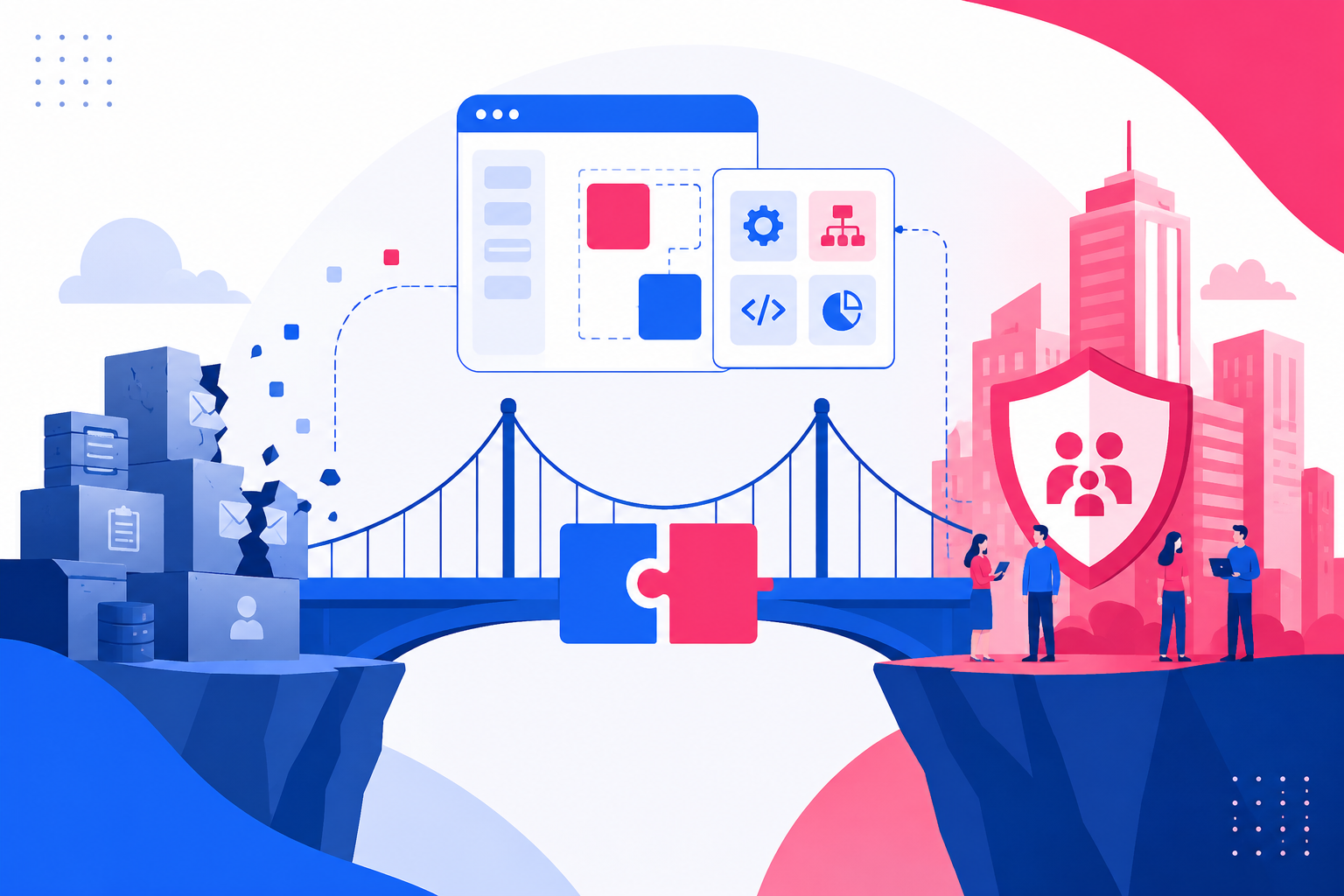
You can ask any technology leader what stands between them and real transformation, and it is rarely a lack of ideas. It is time. The legacy core systems are way too embedded to rip out quickly, and rebuilding them from scratch can take years instead of months. Meanwhile, the customers and regulators keep expecting faster products, faster claims, and faster service. The traditional development would simply not keep pace with that expectation. This is exactly a gap where low-code and no-code platforms are stepping in, not by replacing the core, but by giving insurers a faster, safer way to build on top of it.
Traditional development cannot alone close the gap
The full core replacement in insurance is extremely slow, and even with modern commercial off-the-shelf software, the implementation timeline will often stretch across several years. For an insurer having tried to launch a new product or respond to a shifting regulation, that pace is becoming quite slow.
The low-code/no-code platform seamlessly addresses this by letting the insurers build new workflows and also applications as a layer above the legacy core, instead of waiting for full replacement. This does not eliminate the need for skilled developers; instead, it changes what they spend their time on, and this is how their routine focus shifts from routine build work to business teams while the engineers focus upon integration, security, and harder architectural problems.
Top three architectural reasons for why the industry needs this shift
Here are the top architectural reasons why the industry is in need of this shift:
Legacy infrastructure that cannot be swapped overnight
Most of the insurers still continue running on the core insurance systems, and that includes legacy systems for policy administration, claims, and billing on the systems that were built ages ago. However, replacing them completely is rarely realistic and is also not fully recommended. Today, the insurers need a flexible layer that would help them to modernize without having to topple down their existing core systems.
IT teams are stretching thin
The development capacity in most of the insurance organizations goes toward keeping the existing systems running, thus leaving little room for new builds. This is exactly where the low-code and no-code platforms are shifting the perspective and helping the insurers to move towards saving up a lot of productivity. Additionally, it is also freeing up a lot of time for the developers and concentrating on the tasks that require their expertise.
Regulatory requirements that change constantly
Insurance is one of the most heavily regulated industries in the world, and the compliance requirements often shift. Waiting weeks for a development cycle every time a workflow needs an update will no longer be a sustainable option. The visual, configurable platforms often let the compliance-driven changes happen in days instead of months.
The key impact areas
Here are the key impact areas:
Claims automation
Claims is consistently where the low-code platforms deliver the fastest and most visible return. The businesses and the operations team can adjust the intake forms, routing logic, and adjusting rules directly without having to submit a request and wait for a development sprint to open up. In addition to this, faster claims handling also has got a direct link to customer satisfaction. The slower resolution times are also being strongly associated with lower satisfaction scores across the insurance industry.
Underwriting and policy administration
Configuring the new products, adjusting the rating logic, and automating policy issuance, which used to take months of custom development. With the low-code tools, the underwriting teams will be able to build and test these changes through the visual interfaces, thereby dramatically shortening the path from concept to market.
Customer and agent portals
The policyholders expect a digital-first experience, and the agents expect modern tools to serve them. The low-code no-platforms will let the insurers stand up and continuously improve the self-service portals and agent-facing applications without having the need of a development team behind each and every update.
How to choose the right platform
It’s important to understand that choosing the right platform is not a one-size-fits-all decision. Instead, there are many factors that need to be taken care of.
Here are the top parameters that one needs to keep in mind:
Insurance-specific readiness
Insurance-specific readiness essentially means having a platform where you will find all the pre-built templates and the workflow patterns for claims, underwriting, and policy administration.
Legacy integration depth
It’s not just generic API support. Instead, it’s about having real connectors that are specifically built for the systems insurers would actually run.
Compliance and security posture
This includes the audit trails and the role-based access, which is built into the platform itself.
Scalability
This is so because the platform will be able to handle the real transaction volumes without requiring a redesign later.
Total cost of ownership
This involves factoring in licensing, implementation, and long-term governance.
Top benefits the insurers need to be aware of
Here are the top benefits of having low-code/no-code platforms that the insurers need to be aware of:
Faster product launches
With the low-code and no-code platforms, product launch feasibility is also quite unmatched. The insurers will be able to launch products faster without having to wait upon the limited developer bandwidth.
Lower total cost of ownership
Another one of the key benefits of having low-code/no-code platforms is that there is a lower cost of ownership as compared to fully custom builds.
Greater agility
Another one of the key benefits of having a low-code/no-code platform is there is greater agility in responding to the shifting regulatory requirements.
Reduced dependency
There is reduced transparency on scarce and specialized engineering talent.
Stronger collaboration
Another key benefit of low-code and no-code platforms is that they allow a stronger collaboration between the business teams and IT.
Bottom line
Insurance never really lacked good ideas; instead, it lacked the speed to act on them. The low-code and no-code platforms can easily fix that, and this lets the team build what they need without having to wait in line. It’s important to get the governance right, and this is not just about having a faster way to work. Instead, it’s about the way insurers can stay ahead.