

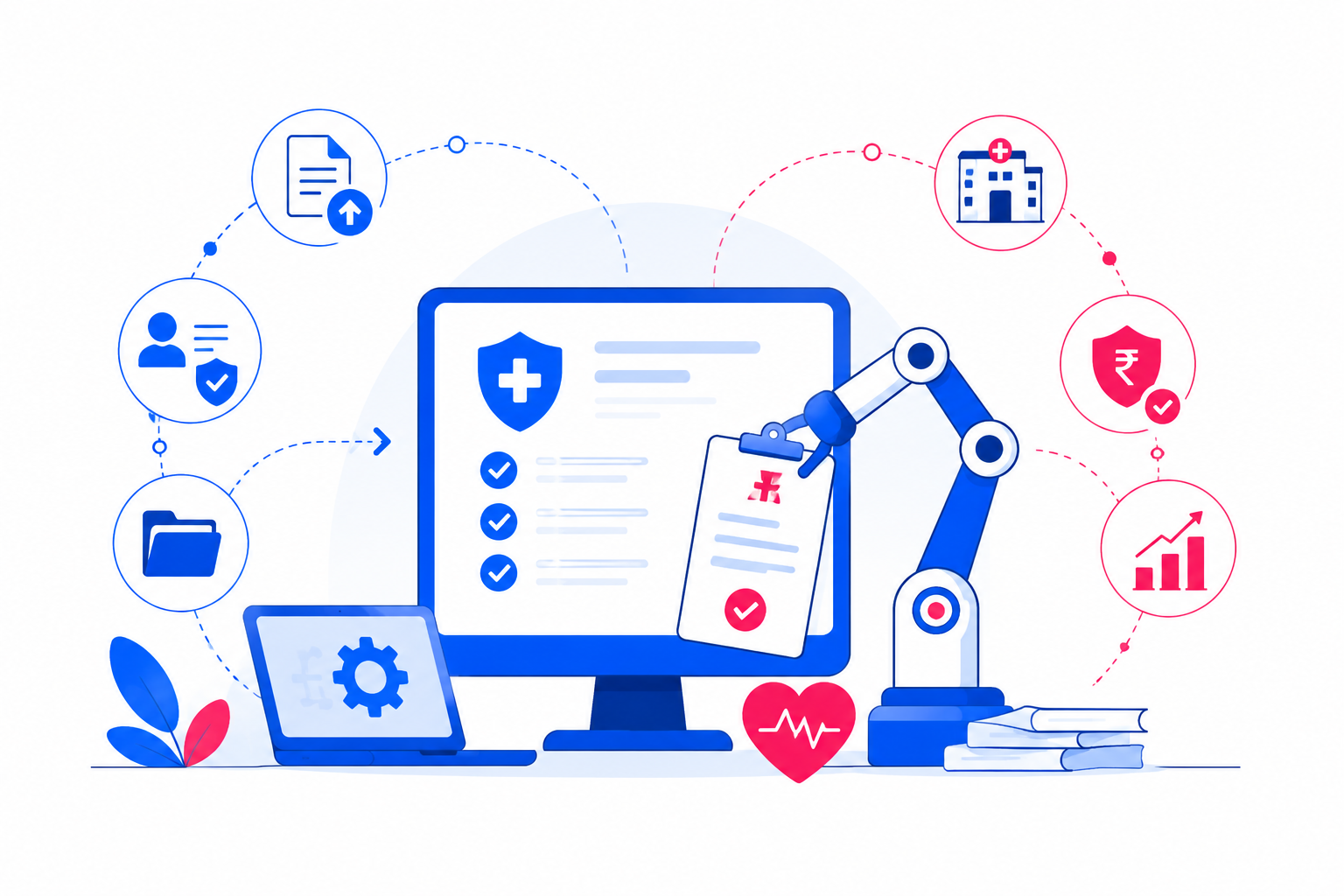
Somewhere between a doctor’s visit and a paid claim, health insurance still moves at the speed of paperwork. There are many hiccups throughout the claims management process that continue to make its way. An adjuster waits on a system that was built for a different decade, followed by multiplication of that friction by millions of claims. At the end, you will be getting an industry that will be quietly bleeding time and money on work that would actually be done by hand.
Zeroing in on the right areas for claims management automation
A typical health insurance claim will be moving through intake, eligibility verification, coding review, adjudication, fraud checks, payments, and the appeal. Each of these stages specifically involves structured or semi-structured data, repetitive decision logic, and higher transaction volume, which specifically involves the exact conditions where automation and AI will thrive.
Here’s how the impact is proving to be helpful:
Claims intake and data capture
Manual data entry still continues to be one of the crucial bottlenecks in claims management. The paper forms, faxed documents, and the inconsistent formatting from the providers all create errors before a claim gets reviewed. The automation tools that use optical character recognition (OCR) and natural language processing can extract, validate, and structure this data in seconds instead of hours.
This is the single stage that often delivers the fastest and also the most visible ROI, all because it removes friction at the very start of the pipeline and also significantly reduces the downstream errors, which would otherwise require a costly rework.
Eligibility and coverage verification
Confirming a patient’s eligibility and the benefits that are used to require phone calls, portal logins, and cross-referencing the multiple systems. The automated eligibility checks now pull up real-time data from the payer databases and flag any discrepancies instantly. This significantly reduces the claims denials, which are caused by the coverage mismatches, which are one of the most common and also preventable reasons due to which claims get rejected at the first instance.
Medical coding and clinical documentation review
This is especially where AI in health insurance is becoming much more powerful. The machine learning models that are getting trained on clinical language will be able to easily cross-check the diagnosis and the procedure codes against the documentation, catching even the slightest mismatches that human reviewers might miss under time pressure.
This essentially does not replace the certified coders and gives them a much faster, more accurate starting point, thereby reducing the coding-related denials in a much more significant manner.
Adjudication and payment automation
For straight-through processing, where the low-complexity claims are automatically adjudicated without any human intervention, it is now becoming a standard practice among the leading insurers. Automation also handles this routine, rule-based claims, freeing the human adjusters to focus on complex, high-value, or disputed cases that genuinely require judgement. This is the shift that does not only speed up payment but also improves accuracy and significantly reduces the administrative cost per claim.
Appeals and denial management
Resources are one of the most resource-intensive parts of claims management. The automated denial tracking systems can easily categorize the denial reasons, predict which appeals are likely to succeed, and even auto-generate the appeal documentation by using historical precedent. This turns a traditionally reactive process into a proactive one.
Automation handles the rules, but AI handles the judgement
It helps in thinking about automation and AI as the two different employees, not as one technology wearing two hats. Automation is quite tireless, and it follows the rules in the most accurate possible manner. With AI, there are a lot of instincts, which notice when something looks off even when there is no rule, although it technically says there is.
A rule-based system will be able to seamlessly flag when a claim misses a required field. However, it is not equipped to tell you a provider’s billing pattern has shifted over the last six months in a way that does not match their specialty. This takes pattern recognition, and that is exactly where AI in health insurance earns its keep.
This is exactly why the insurers who are seeing the biggest gains are not the ones choosing between automation and AI. Instead, they are layering them. Robotic process automation seamlessly clears the repetitive backlog, and AI sits at the top, catching the expectations, the anomalies, and the claims which need a second and smarter look before they even reach a human.
The bottom line
Automation in health insurance is not about replacing the people; instead, it’s about removing the repetitive and error-prone work that slows down the entire system. The biggest impact here comes not from automating everything, but instead, from targeting the stages where manual effort is highest and the error rates are quite costly, involving intake, eligibility, coding, fraud detection and adjudication.