

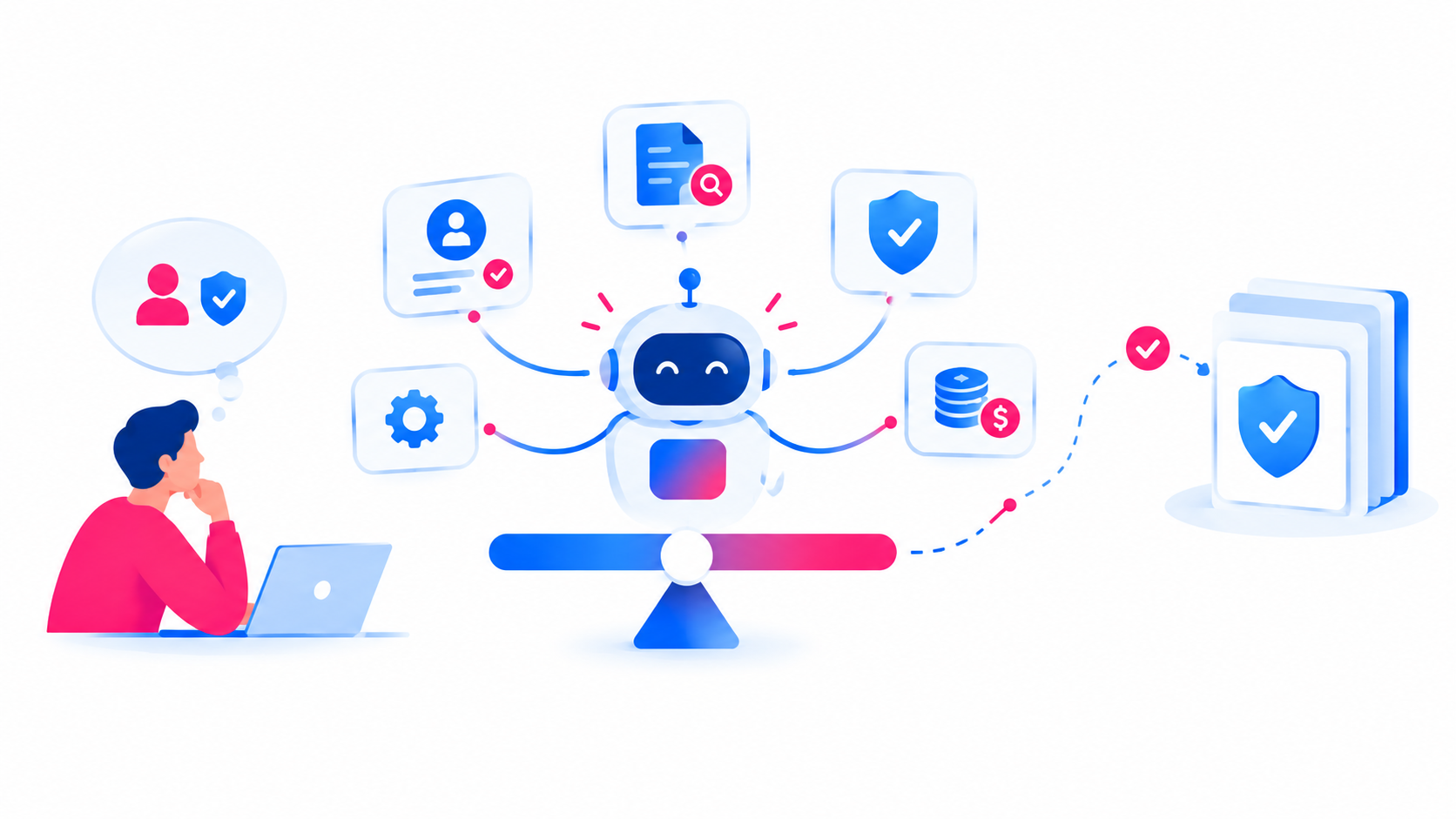
Every great team has got that one moment when a trusted colleague is handed more responsibility, not because of a title but because of what they have shown in sound judgement. The Agentic AI is exactly heading towards that moment in insurance. These are the systems which can now take a goal, plan the steps, and get the work done. This significantly opens up a very fascinating question for the industry: How much freedom is should we give them, and how do we decide?
The question is arriving from the risk side first
The autonomy debate is not only happening inside the technology teams, its not showing up in boardrooms or at the renewal tables. In a recent industry insight, the use of AI was highlighted and cautioned about sweeping the AI exclusions in policies that could leave the clients unsure of what they have recovered at all.
What gives the insight more weight is its firm stance. The report also has highlighted that some of the risks are genuinely new, and it singles out agentic AI, the systems which will be able to decide and act without having a step-by-step human direction, as an area where the insurers, brokers, and the policyholders will be needing to work out on how risk is attributed and also transferred. In other words, the market is signaling that autonomy will be changing the nature of the exposure, not just its size. This is a very useful lens for anyone who is deciding on how much independence to hand an agent.
What truly makes Agentic AI truly different from automation?
The traditional automation follows the scripts. A rules engine approves a windshield claim under a set amount, a workflow which will be routing a document to the right queue. This behavior is quite predictable as the paths are predefined.
Agentic AI is specifically built differently. Its given a goal, and from there on it plans its own steps, that uses the tools and the systems to carry them out, and adapts when something unexpected happens. This flexibility is the entire value, and also the entire risk. An agent can solve a problem in a way which nobody anticipated, this includes the ways that nobody wanted. The more freedom it has, the wider the gap between what is intended and what it might do.
Autonomy is not a switch it’s a dial
One of the most common mistakes in this debate is all about treating autonomy as binary. Either on the human side or on the machine capability. In practice, there is a spectrum, and the insurers will be able to choose a different setting for different tasks.
These include multiple aspects such as:
Suggest- the agent will be gathering the information and recommending. A human will be deciding and then take the action step.
Act with approval- the agent will be preparing the action, this includes drafting a settlement and waits for a person to approve before anything happens.
Act within the limits- The agent will be acting independently inside defined boundaries, this includes paying undisputed claims below a set of value, and escalating anything that is outside them.
Act and report- the agent will be handling the task end to end, with the humans reviewing the outcomes after the fact.
Where autonomy truly makes sense today?
Some of the areas are well suited to greater independence. The routine service requests, address changes, document collection, status updates, and low-value, low-complexity claims, which will all be combining modest consequences with high volume. This gives the agents room here, which frees up people from any repetitive work and also, to a larger extent speeds up the service for customers who simply would want a quick answer.
Where humans should stay firmly in the loop
There are other areas that demand restraint. The claims denials, coverage interpretations, complex liability decisions, vulnerable customer interactions, and anything that touches the regulatory obligations that should keep a person accountable. The customers who are dealing with serious losses often want empathy and a human voice, and not just speed.
Understanding the human side- The agents and brokers
There is another dimension that needs to be highlighted. For most of the insurers, human insurance agents and the brokers will remain the face of the relationship, this is especially in Commercial and complex lines. The Agentic AI should not be positioned against them. The strongest model will be using AI to prepare the client profiles, draft proposals, chase documents and surface the coverage gaps. Hence, the agents and the brokers will be spending more time advising and less time on admin.
Guardrails that make autonomy safe
Any increase in autonomy should come with matching safeguards. Several have become the standard good practice in insurance technology:
Least privilege access
Given each agent only permissions, its tasks require that too with time-limited credentials.
Approvals gates for high impact actions
Payments, policy changes, and customer-facing commitments should require confirmation above the defined thresholds.
Complete the audit trails
Log every step so the decisions can be reviewed, explained and also challenged.
Kill switches
Make sure that every agent can be paused or stopped quickly if it behaves unexpectedly.
Continuous testing
It’s important to evaluate the agents against realistic and adversarial scenarios and keep re-testing them as models and data change.
A better way to earn autonomy
The most sensible paths will be treating autonomy as something which the agents earn, d not something that they have granted upfront. This starts with the agents that assist. This is exactly why it’s important to understand something that measures accuracy, override rates, and customer outcomes. Thus, expand independence only where performance is consistently strong, and pull it back when it isn’t. This builds trust with the employees, customers, and the regulators alike and thereby keeps surprises pretty small.
What’s ahead?
There is no universal answer to how much autonomy is more autonomy, only a disciplined way of deciding task by task. The insurers that match independence to consequence, reversibility, and explainability will be using the Agentic AI to move faster without having to lose control of the outcomes that they are accountable for.


