

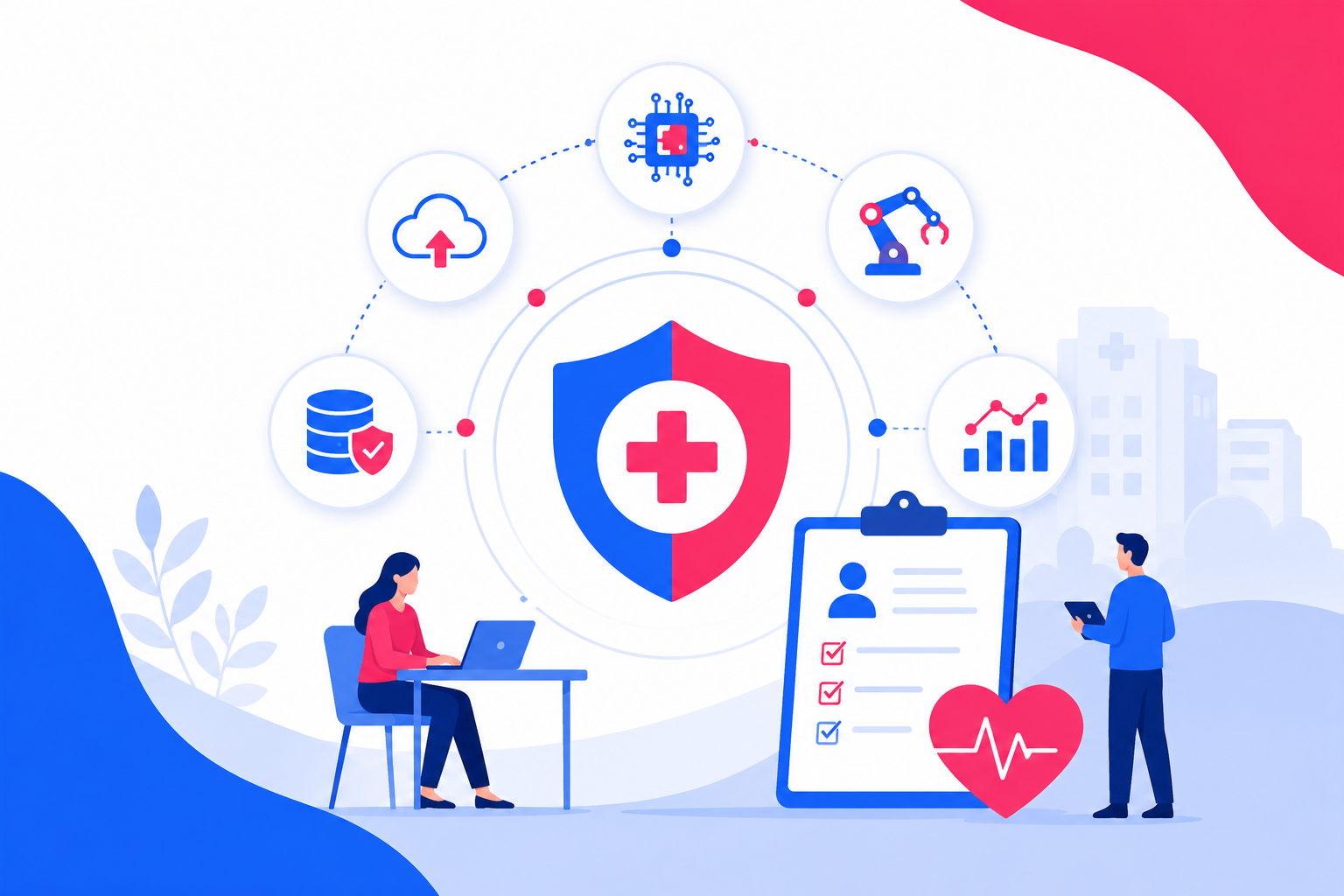
The claims teams are under more pressure than ever. The rising claims volumes, tighter regulations, and policyholders expecting more sophisticated processes have exposed the limits of manual, paper-heavy workflows. For any health insurance provider, the difference between a satisfied member and a lost customer often comes down to how fast and how accurately a claim gets processed. That’s exactly why insurance technology is no longer just a “nice-to-have” instead; it’s the backbone of competitive claims management. Dive in further as we uncover the top five technologies that are shaping the future of health claims management.
Top five technologies for redefining health claims operations
Here are the top five technologies that are truly redefining the claims operations:
Artificial intelligence and machine learning
AI has moved on, carrying the tag of a buzzword to the backbone of insurance operations. The machine learning models today can easily scan the incoming health insurance claims, flag the anomalies, and predict the ones that are likely to be fraudulent or improperly coded. All these essentially happen within just seconds. Instead of the adjusters manually checking upon every line item, the AI systems will triage claims by risk and complexity. This helps them in routing the straightforward cases for auto adjudication while also sending flagged claims to the human experts.
Robotic Process Automation (RPA)
While AI will be handling the judgement-based decisions, the robotic process automation will be handling the repetitive, rules-based work that eats up hours of staff time. This includes data entry, document verification, eligibility checks, and the status updates, which are exactly the kind of tasks that the RPA bots truly excel at. This includes executing them with zero fatigue and near-perfect consistency.
For claims management teams, this means having fewer bottlenecks at intake and the processing stages. A bot will be able to pull the data from the submitted form, validate it against the policy records, and populate the claims system without a single manual click. The result of this is that there will be a leaner operation where the human adjusters can spend their time on complex judgment calls instead of copy-pasting information between systems.
Blockchain for claims transparency
Trust is the true currency of insurance, and blockchain is quietly rebuilding it from scratch. By seamlessly creating a shared, tamper-proof ledger, blockchain allows the insurers, healthcare providers, and even the regulators to view the same version of the claims history in real-time.
This is specifically valuable in Health insurance, where claims would often pass through multiple parties, and this includes hospitals, third-party administrators, and the payers before resolution. A blockchain-based system seamlessly eliminates the redundant verification steps, as every stakeholder already trusts the same source of truth. This also strengthens fraud prevention, since altering a claim record after the fact becomes practically much more impossible.
Cloud-based claims platforms
Legacy, the on-premises claims systems were never specifically built for the scale or the flexibility that the insurance industry today offers. The cloud-based platforms have truly changed this narrative. They are letting insurers scale processing capacity on the basis of demand, integrate new tools without having a lengthy IT overhaul, and give distributed teams real-time access to the same claims data from anywhere.
The cloud infrastructure here has also made it far easier to plug in the other technologies on this list. The AI models, RPA bots, and the analytics dashboards all run much more efficiently when they sit on a modern, cloud-native architecture instead of the patchwork of the legacy servers.
For claims management specifically, this translates into a much faster deployment of new features, better disaster recovery, and much lower long-term IT costs. All these will also be maintaining the security standards that the insurance data demands.
Predictive analytics and data intelligence
The fifth technology that is reshaping the claims operations is not a single tool but a discipline: predictive analytics. By analyzing the patterns across millions of historical insurance claims, predictive models can easily forecast the claims volume spikes, identify the high-risk policyholders, and also estimate the likely cost of a claim before it is fully processed.
This is the foresight that truly changes the way insurers staff their claims teams, allocate the reserves, and design fraud detection strategies. Instead of reacting to a surge in claims after it happens, predictive analytics allows the teams to prepare well in advance. This significantly improves the member experience; when the insurers can anticipate common claim scenarios, they can proactively communicate with the policyholders. This significantly helps in reducing the frustrating back-and-forth that would often damage trust in the claims process. With every improvement in data quality, the need for insurers to adopt predictive tools will be much higher. This is the capability that is fast becoming a competitor advantage instead of an experimental add-on.
Why does this matter more than ever?
Each of the above technologies plays a pivotal role in solving different pieces of the claims puzzle. However, together they essentially represent a fundamental shift in the way the industry operates. AI and predictive analytics bring together intelligence for decision-making. RPA removes friction from repetitive tasks, while blockchain technology builds trust across the stakeholders. Additionally, the cloud platforms provide a solid foundation that ties everything together in a cohesive technology ecosystem, which is built to transform health claims management going forward.
Conclusion
The health claims operations are evolving fast, and the insurers would be embracing these technologies as they keep pace with the growing technology trends. AI, RPA, blockchain, cloud platforms, and predictive analytics are not isolated trends. Instead, they will be the connected foundation of modern and efficient claims management.